Introducing the openQCM Advanced Calculator: Three Models, One Click, Zero Installation

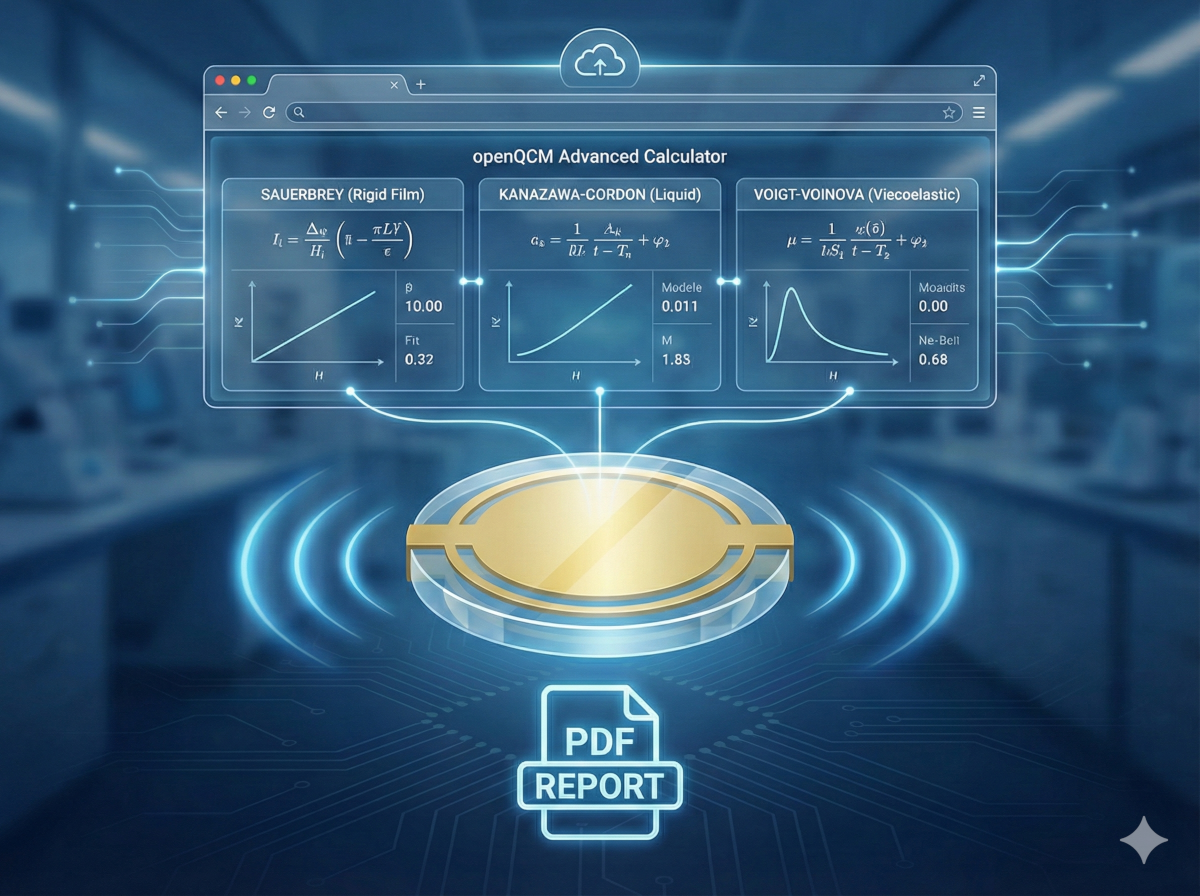
Three models. One interface. No installation. Today we’re releasing a tool we’ve wanted to build for a long time: a unified QCM calculator that covers the full range from rigid films in vacuum to viscoelastic layers in liquid — entirely in your browser.

If you work with QCM, you’ve almost certainly done this: opened a spreadsheet, typed in the Sauerbrey equation, double-checked the quartz constants, and hoped you didn’t make a sign error somewhere. For quick estimates, that works fine. But when you need to switch between models, compare regimes, or generate a clean report for a publication — it gets tedious fast.

The openQCM Advanced Calculator is our answer to that problem. It’s free, it runs entirely in the browser, and it’s available right now.

Launch the openQCM Advanced Calculator


Why a Unified Calculator

QCM is deceptively simple in principle — a mass on a vibrating crystal shifts the frequency — but the physics changes dramatically depending on what’s on the surface and what medium surrounds it.

A rigid metallic thin film in vacuum? Sauerbrey is all you need. A Newtonian buffer solution in a flow cell? You want Kanazawa-Gordon. A hydrated protein layer that’s neither fully rigid nor fully liquid? That’s Voigt-Voinova territory, and the equations get considerably more involved.

Most online tools cover only the first case. We wanted a single environment where all three models coexist with consistent notation, proper physical constants, and diagnostic guidance to help you decide which model applies to your experiment.

The Three Models

1. Sauerbrey — Rigid Film in Air or Vacuum

The foundational equation of QCM. For a thin, rigid, uniformly distributed film that oscillates in phase with the crystal, the frequency shift is directly proportional to the adsorbed mass per unit area:


\Delta f = -\frac{2 f_0^2}{A \sqrt{\rho_Q \mu_Q}} \, \Delta m


The calculator takes as input the fundamental frequency f0, the electrode diameter, the measured Δf, and the sample density ρf. From these it derives the mass sensitivity constant Cf, the film thickness, and the total mass change Δm.

It also computes the mass saturation limit and maximum sample thickness — useful checks to verify that your measurement stays within the validity range of the rigid-film approximation (|Δf|/f0 ≪ 1).

When to use it: Thin metallic films, oxide layers, self-assembled monolayers in air, any deposition where dissipation is negligible and Δf/n is approximately constant across harmonics.

Reference: G. Sauerbrey, Z. Phys. 155, 206–222 (1959)

2. Kanazawa-Gordon — Newtonian Liquid Loading

When one face of the crystal contacts a bulk liquid, the oscillating surface generates a shear wave that decays exponentially into the fluid. The result is both a frequency decrease and an increase in dissipation. Kanazawa and Gordon showed that for a semi-infinite Newtonian liquid:


\Delta f = -f_0^{3/2} \sqrt{\frac{\rho_L \eta_L}{\pi \rho_Q \mu_Q}}


The calculator supports two operating modes:

Forward mode. You provide the liquid density ρL and viscosity ηL. The calculator predicts Δf, the dissipation change ΔD, and the viscous penetration depth δ.

Inverse mode. You provide a measured Δf. The calculator extracts the product ρL·ηL and, given the density, the liquid viscosity.

The viscous penetration depth δ tells you how far the acoustic shear wave extends into the liquid — typically a few hundred nanometers at MHz frequencies. This is an important parameter: anything beyond δ from the surface is effectively invisible to the QCM.

Reference: K.K. Kanazawa & J.G. Gordon II, Anal. Chem. 57, 1770–1771 (1985)

3. Voigt-Voinova — Viscoelastic Film Analysis

This is where things get interesting. Many real-world films — polymer brushes, hydrogels, protein adlayers, DNA monolayers — are neither rigid nor liquid. They are viscoelastic: they store some energy elastically and dissipate the rest.

The Voigt-Voinova model treats the film as a Kelvin-Voigt element with a complex shear modulus:


G^* = G' + iG''


where G′ is the storage (elastic) modulus and G″ is the loss (viscous) modulus. The loss component can equivalently be expressed as a film viscosity: G″ = 2πfηf.

The calculator takes as input the film density, thickness, both modulus components, and — optionally — the bulk liquid properties (for films operating in liquid). It then predicts:

Frequency shift Δf and dissipation change ΔD

ΔD/|Δf| ratio — a diagnostic that helps distinguish rigid from viscoelastic films

Loss tangent tan(δ) = G″/G′ — classifies the film regime

Sauerbrey rigid-film limit ΔfS — for direct comparison with the full viscoelastic prediction

If Δf ≈ ΔfS and ΔD is small, your film is effectively rigid and Sauerbrey is sufficient. If they diverge significantly, viscoelastic effects dominate and a more complete model is required.

Reference: M.V. Voinova et al., Phys. Scr. 59, 391–396 (1999)


PDF Report Generation

Every calculation can be exported as a professional PDF report, ready for your lab notebook, a publication supplement, or a project deliverable.

Each report includes:

All input parameters and computed results, clearly tabulated

Proper mathematical notation — Δf, ρ, η, δ, G′, G″ rendered correctly

AT-cut quartz constants — ρQ, μQ, ZQ for reference

A didactic description of the model used, explaining the physics and input parameters

The original literature reference

The PDF engine is fully embedded — no external CDN dependencies, no network requests. It works offline, behind firewalls, and in restrictive IT environments. This was actually a non-trivial engineering challenge: the jsPDF library is inlined with a custom module-detection wrapper, and all mathematical symbols are rendered through an offscreen canvas to bypass the limitations of standard PDF fonts. But that’s a story for another blog post.


Design Principles

A few decisions we made deliberately:

Zero installation

Pure HTML/CSS/JavaScript. No backend. No account. No cookies. Your data stays on your machine.

Real-time feedback

Results update instantly as you type, so you can explore how parameters affect the output without hitting a “calculate” button.

Educational by default

Every PDF report explains the model, not just the numbers. Useful for teaching, for onboarding new lab members, and for your own reference.

Built with AI, Guided by Physics

In the spirit of openness that defines the openQCM project, we want to share how this tool came to life.

The openQCM Advanced Calculator was developed in close collaboration with Claude, Anthropic’s AI assistant. Claude contributed to the interface design, the implementation of the three physical models, the self-contained PDF export engine, and the didactic descriptions that accompany each report.

The process was not “we told an AI to make a calculator.” It was a genuine iterative dialogue — domain expertise driving the physics, the AI handling the implementation, and constant back-and-forth to refine both. We tested every formula against known analytical solutions and reference papers. The result is something neither side would have built alone, and we think it represents an interesting model for developing scientific tools.

We mention this not as a marketing exercise, but because we believe transparency about methods matters — in science and in engineering alike.

We Want Your Feedback

This calculator is a starting point, not a finished product. It covers the three foundational QCM models, but QCM science is much broader than that. We have ideas for future development, but what matters most is what you need in your lab.

Are there additional models you would like us to implement? Multi-overtone Sauerbrey fitting, Kelvin-Voigt parameter extraction from multi-harmonic data, BVD equivalent circuit analysis?

Would new features be useful? Data import/export, graphical parameter sweeps, comparison between models on the same dataset?

Did you find something that doesn’t look right? An edge case, an unclear label, a unit conversion that seems off?

Every suggestion from the research community helps us make the tool better for everyone. Please share your thoughts through the openQCM Forum or contact us directly.

Try It Now

The openQCM Advanced Calculator is free, open, and ready for your next experiment:

openqcm.com — QCM Advanced Calculator

We hope it saves you some spreadsheet headaches and becomes a useful companion at the bench. Happy measuring.


Questions, feature requests, or bug reports? We’d love to hear from you — get in touch or join the conversation on the openQCM Forum.
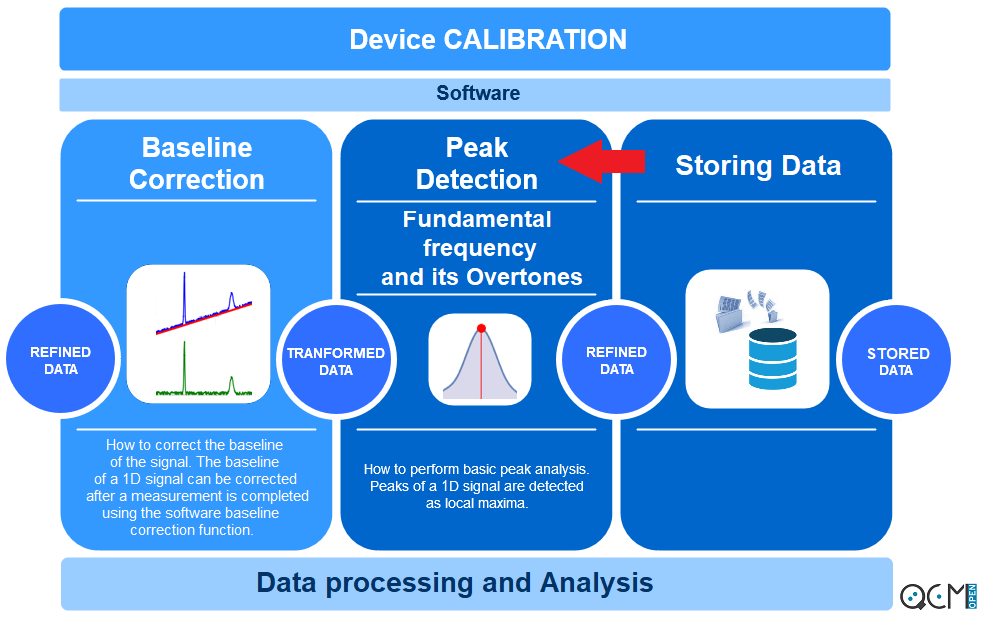
Introducing the new openQCM Q-1 Python Software

The new openQCM Q-1 Python Software: real-time monitoring of frequency and dissipation variations of a Quartz Crystal Microbalance through the analysis of the resonance curve

Continue reading “Introducing the new openQCM Q-1 Python Software”

An exciting year

Hello, everyone. This 2018 has been a very exciting year. The openQCM project is growing beyond our expectations. We have launched 2 new devices and are working on the development of new scientific tools, which I hope will help the world of research in a completely new way. For this reason, we have temporary neglected our blog, although we have reported all our developments on Researchgate. Now that some of the most challenging work has been done, we can finally publish a series of posts dedicated to the complex development of the new Python software. Vittorio, who was personally involved in the development of the software, will describe every step and the updates that will take place in the near future. It comes from a constant exchange of with the scientific community and is constantly being developed.we would like to thank warmly all the researchers who have helped us. I hope that this will be of interest to you. Thanks again to all (Raffaele and Marco)


Start to read the new series of posts:  Introducing the new openQCM Q-1 Python Software

openQCM test of quartz crystal in contact with liquid

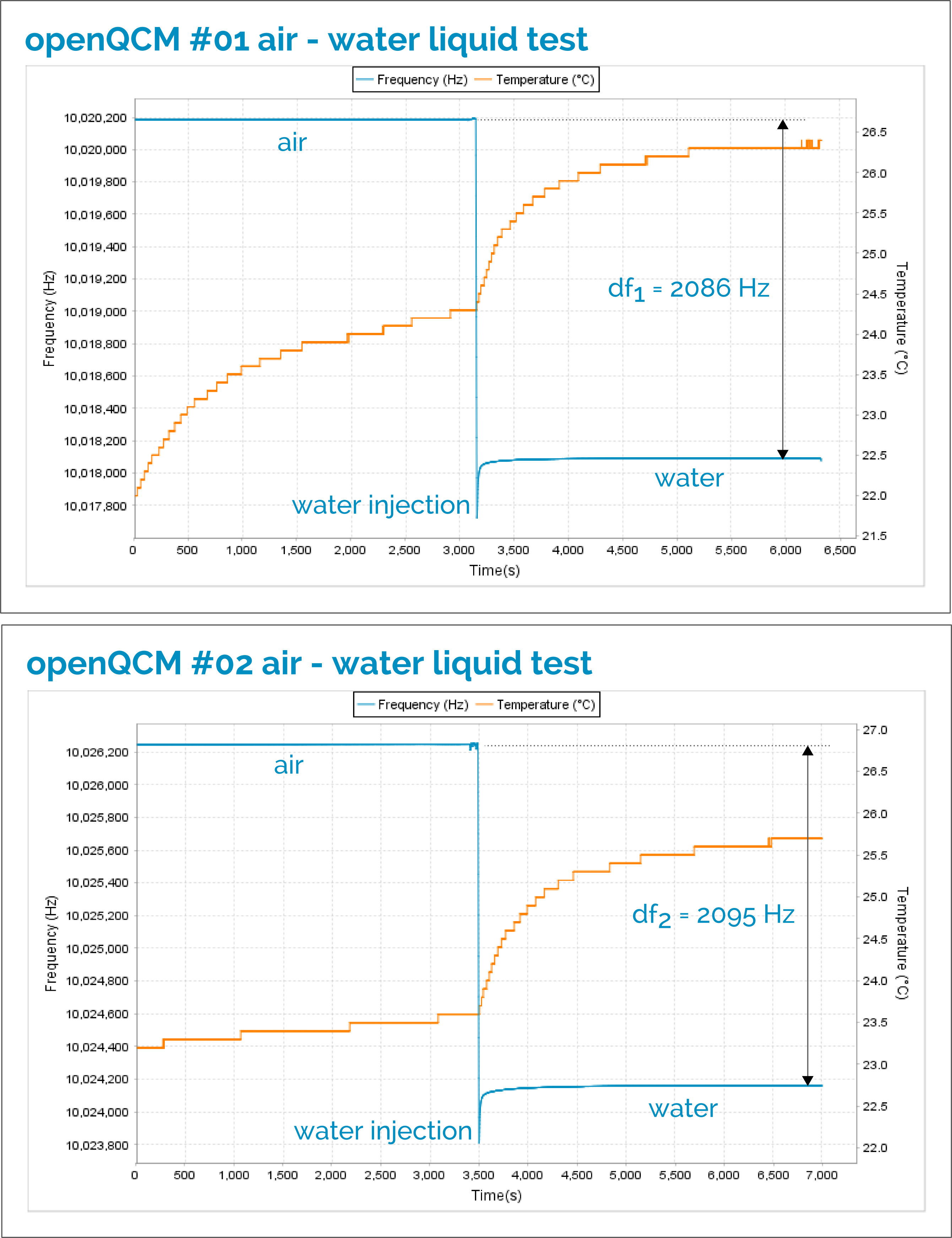
Here we report in detail the verification test of openQCM Quartz Crystal Microbalance in contact with pure water according to the theory based on Kanazawa – Gordon equation

Continue reading “openQCM test of quartz crystal in contact with liquid”

openQCM verification test using Impedance and Network Analyzer

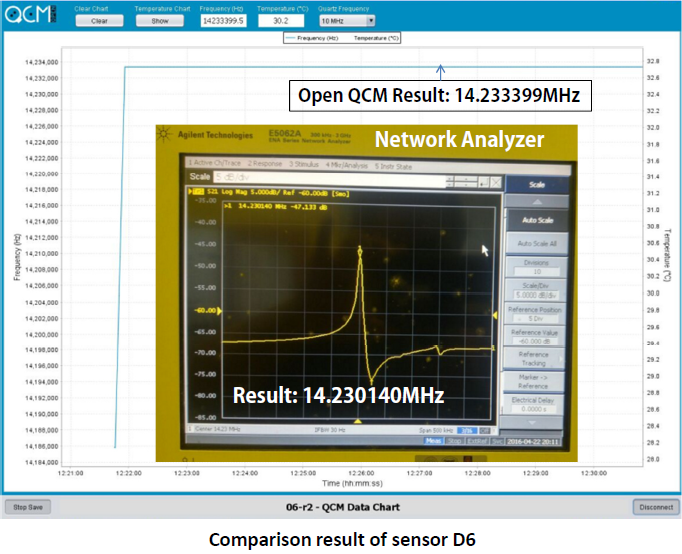
Researchers working at International University of Malaysia compared openQCM Quartz Crystal Microbalance with standard scientific instruments Network and Impedance Analyzer

Continue reading “openQCM verification test using Impedance and Network Analyzer”

Why the open source hardware will change the Science

A year has already gone by the   launch of openQCM and there are many things to tell. When we have tried as private company, the way of the open source by launching one of the first scientific analytical instrument in the world completely open hardware, we would never have imagined this level of success. We designed the OpenQCM for a market sector that we thought very restricted: the Quartz Crystal Microbalance.

The evening of the launch we had sold more than 8 devices, and at the end of this year we have sold hundreds of products in many countries of the world and especially to the most important research institutes and large private companies that we had not taken in account. Before the launch, I would have called a success the overall sale of 30 units!


Basically, that which is born almost on a bet, has become an unexpected and very important component of our business …. to such an extent to lead us to take up this new road in a more systematic way, with the design and the realization of new open-source scientific products, that we will launch soon through the openQCM platform.

The fundamental reason why I write this is to share our experience and to encourage those who want to see their new product realized. Novaetech, the company that we founded more than 10 years ago, was born with the purpose of delivering services and custom systems for the research world. We started our adventure in the field of aerospace, and then we have differentiated our business over time. These activities have allowed us to achieve a number of prototypes, which were supposed to be turned into real products. Unfortunately, the dream often must face the reality, especially if one works at a national context such as our country, Italy, where to invest the money on an idea is nearly unimaginable.

Throughout these years, we have contacted and met countless potential investors in order to find the necessary resources for the realization of a first prototype. Indeed, every time we have found locked doors …. and in the meantime our prototypes kept closed in a drawer or relegated to extremely limited and specific applications and uses. After all, our company did not have enough resources to get to start production or even distribute new products.

At the same time, the international economic crisis has had as consequence the contraction of our turnover, risking to drift a decade of hard work. It was in these circumstances that, at the end of 2014, we have decided to change strategy thinking it would be better to loan our ideas to the rest of the world rather than keeping them closed and unused, perhaps forever … and this was a winning move!

I have always been a fan of the open source concept, and among early adopters since the beginning of the ‘90s with Linux. I remember how the discovery of a different way of thinking about the software, through an open approach to share and develop, was at that time revolutionary and at the same time exciting and thrilling. Then, in the last few years, this concept has been extended to the hardware, with benefits and implications that even today I think it is difficult to understand.

The Open Source / Open Hardware strategy is and will become more and more an important resource in the world of research and business, especially for small companies like ours, as well as for individual Makers, Designers, and Research institutes and even, I believe with certainty, for the large companies … and the corporations have shown us a willingness to use open source technology!

In these days, we are seeing the establishment of a shared Manifest for Open Hardware in the field of science.  The access to Open Source scientific instrumentation will bring down the gap between the richest countries and those that, at the present, have no chance to devote large resources to research. All thanks to a growing team of people involving makers, scientists, engineers, programmers …. a movement that starts from the base and results in an overturning of the concept: “I invest only where there the market is.”

A movement that is involving even openQCM device, which, with the help of researchers and users, has led us perfecting the device and planning the release of new versions with more features and performances. Many researchers, in fact, have not merely used the openQCM device, but also actively contributed to the future development. They have provided basic information, creating an increasingly broad base of testers. Today we can say, thanks to them, that openQCM device works better than our preliminary expectations and that there is still much work to be done, no more alone, but with the community that has grown with us in the last year.
I conclude with an encouragement to those who not yet started this type of adventure. Do you have an idea? Try it and you will see that so many people across the network certainly are expecting an idea to come out … and this will help you with the support and cooperation characterizing an open movement.


Raffaele

openQCM frequency stability of quartz crystal microbalance in typical experimental conditions

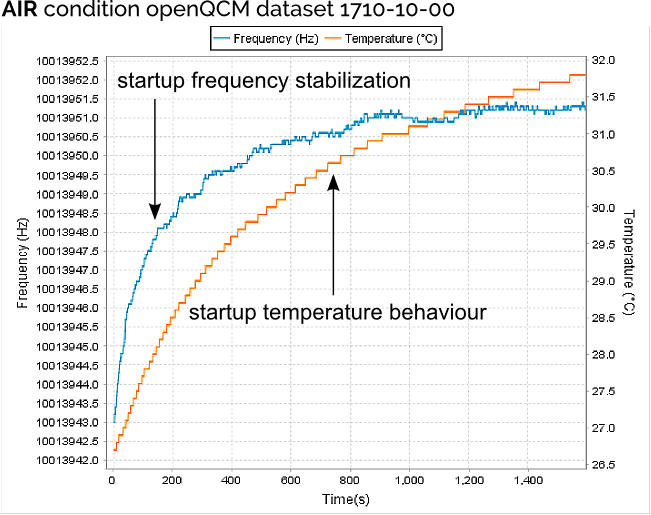
We are now testing the performances of two different openQCM devices in the most typical experimental conditions in order to measure the frequency stability of the open source quartz crystal microbalance. Continue reading “openQCM frequency stability of quartz crystal microbalance in typical experimental conditions”

openQCM news and press review

openQCM quartz crystal microbalance press review release
openQCM quartz crystal microbalance press review

The openQCM is really proud to share the latest reviews about the open source quartz crystal microbalance. This is also the opportunity to give thanks to people supporting the openQCM project. Continue reading “openQCM news and press review”

openQCM the Java application for developers

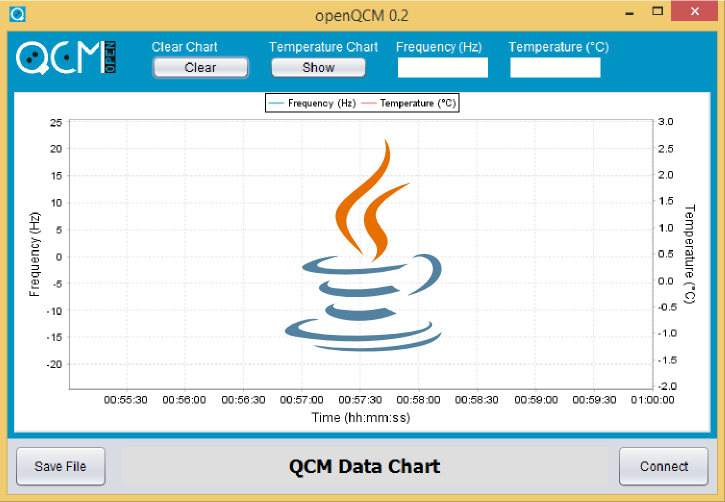
In this post I discuss in detail the development of Java application for the open source quartz crystal microbalance openQCM. This post is intended for developers and contributors of the open source project. The entire project is available on github repository at this link Continue reading “openQCM the Java application for developers”

Quartz Crystal Microbalance openQCM: our first test

As already mentioned, we have just completed the design and the electronic optimization of the Quartz Crystal Microbalance openQCM. At the moment we already have 2 working devices. So, we are very glad to show the first test in liquid environment.

In order to demonstrate the real behavior of the system  we have preferred to make a video. In my opinion is the best way to highlight the openQCM performances. Furthermore, it is a good opportunity to view the Java software in action!

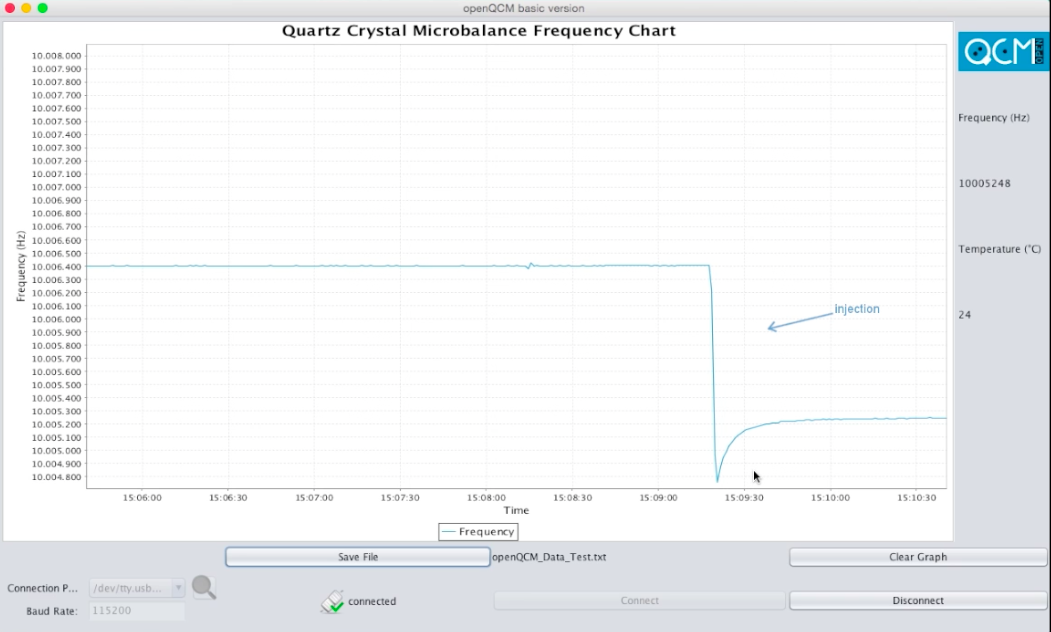
openQCM is a system designed for working both  in air in liquid environments, the latter being the most challenging in terms of frequency noise and oscillator circuit design. The main aim of the experimental test are measuring:

  1. The frequency signal stability in air and liquid environments;
  2. The typical system equilibrium time after the liquid injection.

We chose to report raw data without any kind of data processing. This is very important for the evaluation of the performances of a sensing device, that’s the best way to appreciate the quality of opeQCM. In the final version of the  software we will use an algorithm for signal processing, in order to drastically increase the S/N ratio. But as you will see, the “raw” results are very exiting !

In this test we use a AT-cut quartz crystal at 10 MHz, pure water and a CellTram Oil microinjector.  The first part of the test was in air and after few minutes we injected water in the chamber. After the injection we collected more than 1/2 hour in order to evaluate the long time behaviour of the quartz sensor in liquid.

The first exciting results is that after the water injection, the system reached the thermal equilibrium in only few minutes. The second great results is the perfect horizontal plateau which remains at the same stable level for the rest of the experimental test.

If you want to evaluate by youself the quality of raw data you can download the data file here.


[youtube http://www.youtube.com/watch?v=7BaVTjCExys]