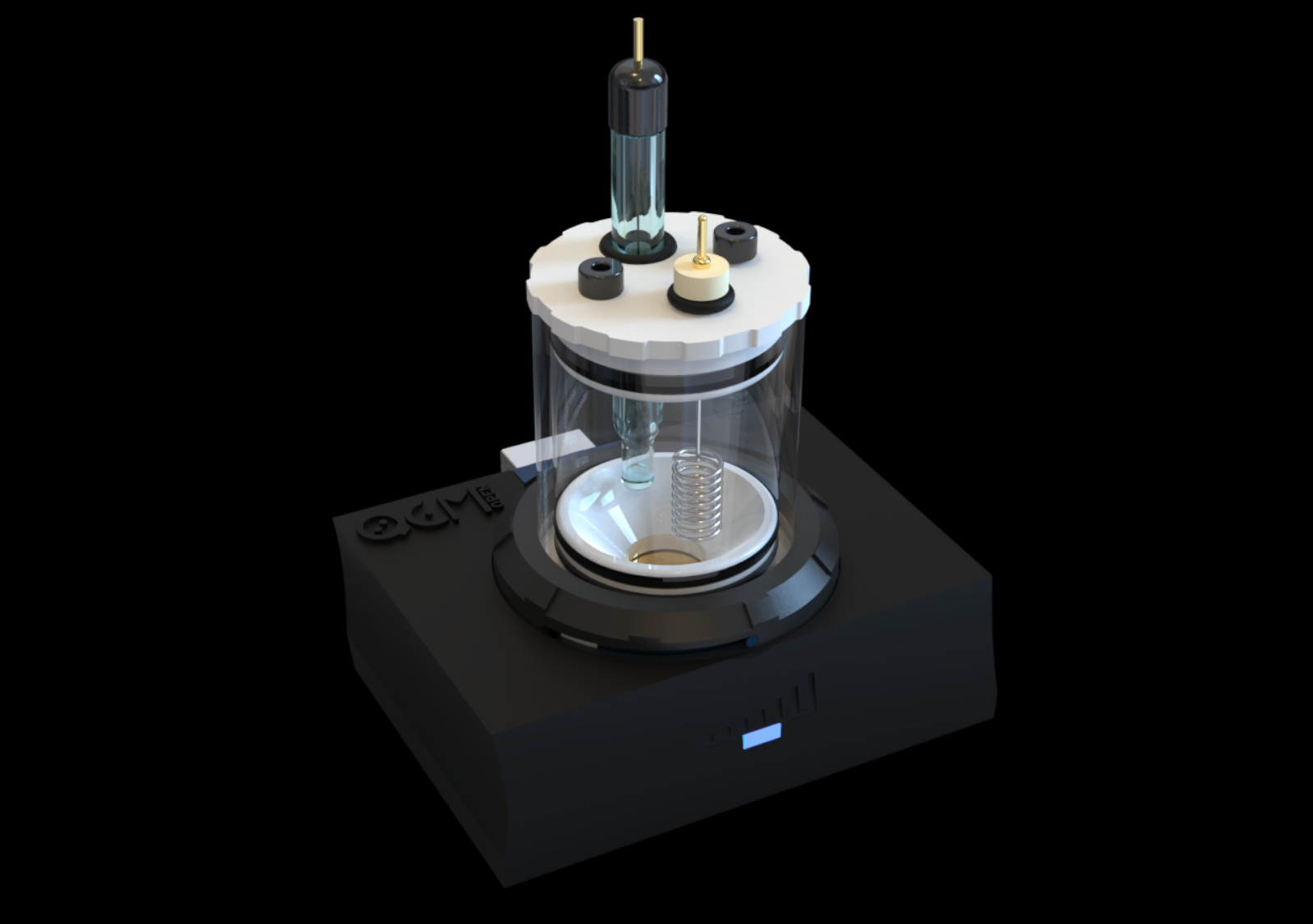
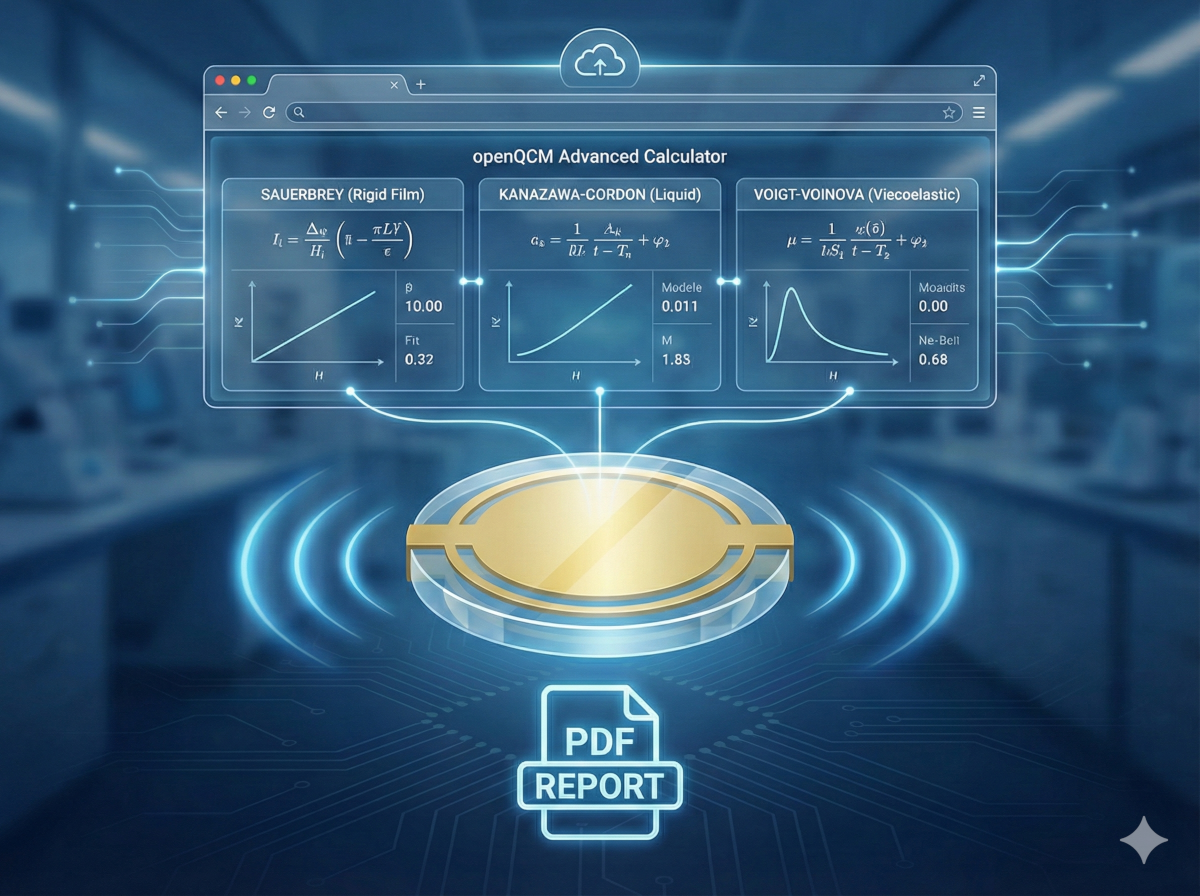
How do openQCM Q-1 and openQCM NEXT measure dissipation across multiple harmonics?


Ever wondered what really happens when your openQCM measures dissipation? Today we’re opening the hood and showing you exactly how it works—including the engineering challenge that made us rethink the standard approach.

One of the questions we get asked most often is: “How exactly does the dissipation measurement work?”

It’s a fair question. And honestly, the answer involves a bit of creative problem-solving that we think you’ll find interesting—especially if you’ve ever struggled with measurements in viscous solutions or wondered why your higher overtones sometimes behave unexpectedly.

The Sensing Principle

openQCM Q-1 and openQCM NEXT measure two parameters simultaneously: frequency (related to mass changes) and dissipation (related to viscoelastic properties). This dual measurement capability is what makes QCM-D such a powerful technique for characterizing soft matter, biological films, and polymer layers.

Unlike systems based on oscillator circuits or the ring-down technique, our instruments employ a scalar network analyser approach. We passively interrogate the quartz crystal by performing a frequency sweep around the resonance, generating a sinusoidal signal and measuring the amplitude of the crystal’s response.

Think of it as gently probing the system across a range of frequencies rather than forcing it to oscillate at a predetermined point. This approach allows us to reconstruct the complete resonance curve and extract both frequency and bandwidth information.

Building the Resonance Curve

The measurement process is conceptually straightforward:

Step 1. Set an excitation frequency f₁ and measure the response amplitude

Step 2. Increment to f₂, f₃, f₄… measuring each response

Step 3. The complete set of points defines the resonance curve

Step 4. Repeat for each harmonic: fundamental, 3rd, 5th, 7th overtone…

From this curve, we extract the resonance frequency (the peak position) and the bandwidth (the peak width), which is directly related to energy dissipation in the system.

The Classical Approach: −3 dB Bandwidth

The standard definition of dissipation is elegantly simple:


D = \frac{1}{Q} = \frac{\Delta f}{f_r}


where Δf is the bandwidth measured at the −3 dB level (half-power points), corresponding to an amplitude of Apeak/√2. This definition has solid physical grounding: it relates directly to the energy dissipated per oscillation cycle.

In an ideal world, this would be all we need. However, real-world measurements—particularly at higher overtones—present a challenge that isn’t always discussed in textbooks.

The Overtone Problem

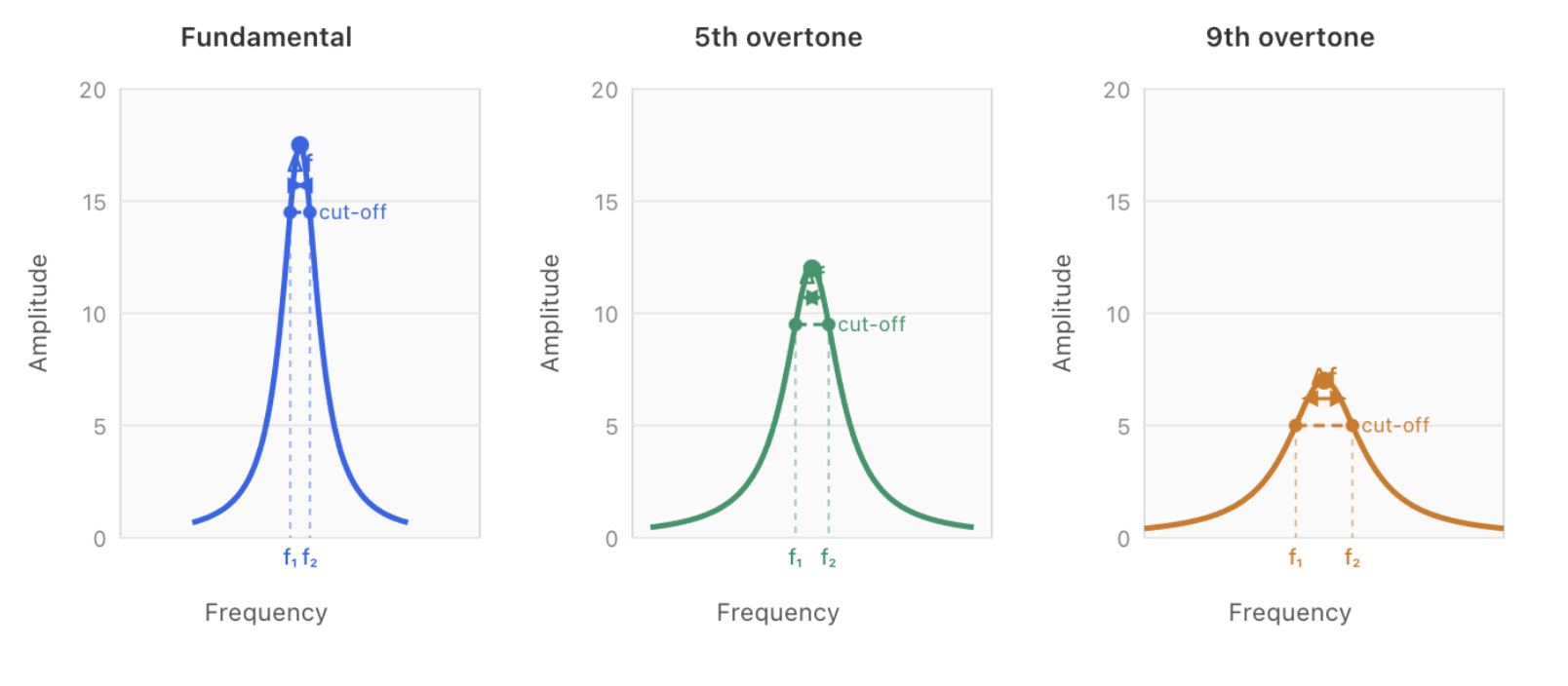
During extensive testing of our instruments, we observed something important: the amplitude of resonance peaks decreases significantly as the overtone order increases.

If your fundamental at 10 MHz shows a peak amplitude of 18 arbitrary units, the 5th overtone might reach only 12–14 units, and the 9th overtone even less. This occurs due to several physical

When rigidly applying a fixed cut-off level criterion to an overtone with reduced peak amplitude

factors:

  • Reduced mechanical displacement at higher harmonics
  • Frequency-dependent coupling efficiency between electronics and crystal
  • Increased energy losses at higher frequencies

When the peak amplitude becomes s

ufficiently low, the standard −3 dB approach encounters practical difficulties:

Noise floor proximity. The −3 dB cut-off level approaches the system noise, making precise identification of f₁ and f₂ difficult.

Degraded signal-to-noise ratio. Small fluctuations translate into significant bandwidth errors.

Undefined intersections. In extreme cases, the −3 dB level may not clearly intersect the resonance curve at all.

If you’ve ever experienced unstable dissipation readings at higher harmonics, this is likely the underlying cause.

Our Approach: Adaptive Cut-off Levels

Faced with this limitation, we had two options: accept that higher overtones would be inherently unreliable, or develop a more robust methodology. We chose the latter.

openQCM Q-1 and openQCM NEXT employ a custom cut-off level for each harmonic, defined as:

A_{cutoff,n} = A_{peak} - \Delta A_n

where ΔAn is an amplitude offset calibrated for each overtone during instrument setup, ensuring the measurement remains well above the noise floor while still capturing the relevant portion of the resonance curve.

The ΔAn values are determined during instrument calibration, optimized for each harmonic to balance noise immunity with measurement sensitivity.

 A custom cut-off level for each overtone rather than the fixed -3 dB level.
The cut-off level for bandwidth determination (Δf = f₂ − f₁) is calculated relative to each harmonic’s peak amplitude, ensuring reliable dissipation measurements even as signal amplitude decreases at higher overtones.

Physical Interpretation

We want to be transparent about what this methodology means for your data.

The parameter we measure—denoted Dn(inst) (instrumental dissipation)—is systematically related to, but not numerically identical to, the canonical dissipation factor defined at −3 dB. The absolute values will differ.

However, and this is the key point:

Relative variations ΔDn(inst) faithfully track real changes in energy dissipation. When your film softens, D increases. When it rigidifies, D decreases. The trends are physically meaningful and reproducible—which is precisely what matters for real-time monitoring experiments.

For applications requiring absolute comparison with literature values, correction factors can be applied to map the measured bandwidth to the equivalent −3 dB value. This mapping depends on the resonance lineshape and can be determined analytically for Lorentzian resonances or empirically using reference measurements.

Multi-Harmonic Analysis

One of the strengths of QCM-D is the ability to probe your sample at multiple frequencies simultaneously. Different overtones are sensitive to different effective depths within the contacting medium:

Lower Harmonics

Greater penetration depth. Sensitive to the bulk properties and entire film thickness.

Higher Harmonics

Smaller penetration depth. More sensitive to surface and near-surface layers.

Comparing dissipation across harmonics provides insight into the vertical structure of your film. Is it homogeneous throughout? Does the surface behave differently from the bulk? Multi-harmonic data helps answer these questions.

Rigidity Verification

For rigid films where the Sauerbrey equation applies, you should observe:

  • Δfn/n approximately constant across all harmonics
  • Dn values remaining low and relatively constant

Significant deviations from this behavior—particularly D values that increase with overtone number—indicate viscoelastic contributions that require more sophisticated modelling approaches such as the Voigt or Maxwell models.

Practical Recommendations for Viscous Solutions

Based on our experience supporting researchers across diverse applications, here are some practical suggestions for working with high-viscosity samples:

Widen the frequency sweep range. Viscous loading significantly broadens the resonance peak. Ensure your sweep captures the complete curve, including the tails.

Increase the number of sampling points. Higher point density improves the accuracy of peak detection and bandwidth determination, particularly for broad, low-amplitude resonances.

Prioritize lower harmonics. The fundamental and 3rd overtone typically provide the most reliable signal in viscous environments, where higher overtones may be strongly attenuated.

Summary

openQCM Q-1 and openQCM NEXT measure dissipation by reconstructing the resonance curve through frequency sweeps and calculating the bandwidth for each harmonic.

Our adaptive cut-off methodology addresses a practical limitation of the standard −3 dB approach: the reduced signal amplitude at higher overtones. By using harmonic-specific cut-off levels calibrated above the noise floor, we ensure reliable dissipation measurements across all available overtones.

Is this a departure from the canonical definition? Yes. Does it provide meaningful, reproducible, physically relevant data for monitoring viscoelastic changes in real-time? Absolutely.

The multi-harmonic dissipation data, combined with frequency shift measurements, enables characterization of soft films, hydrated layers, and biological samples where the Sauerbrey equation alone is insufficient.


Questions about our measurement methodology or need assistance optimizing your experimental setup? We’re always happy to discuss—get in touch or leave a comment below.

Why the open source hardware will change the Science

A year has already gone by the   launch of openQCM and there are many things to tell. When we have tried as private company, the way of the open source by launching one of the first scientific analytical instrument in the world completely open hardware, we would never have imagined this level of success. We designed the OpenQCM for a market sector that we thought very restricted: the Quartz Crystal Microbalance.

The evening of the launch we had sold more than 8 devices, and at the end of this year we have sold hundreds of products in many countries of the world and especially to the most important research institutes and large private companies that we had not taken in account. Before the launch, I would have called a success the overall sale of 30 units!


Basically, that which is born almost on a bet, has become an unexpected and very important component of our business …. to such an extent to lead us to take up this new road in a more systematic way, with the design and the realization of new open-source scientific products, that we will launch soon through the openQCM platform.

The fundamental reason why I write this is to share our experience and to encourage those who want to see their new product realized. Novaetech, the company that we founded more than 10 years ago, was born with the purpose of delivering services and custom systems for the research world. We started our adventure in the field of aerospace, and then we have differentiated our business over time. These activities have allowed us to achieve a number of prototypes, which were supposed to be turned into real products. Unfortunately, the dream often must face the reality, especially if one works at a national context such as our country, Italy, where to invest the money on an idea is nearly unimaginable.

Throughout these years, we have contacted and met countless potential investors in order to find the necessary resources for the realization of a first prototype. Indeed, every time we have found locked doors …. and in the meantime our prototypes kept closed in a drawer or relegated to extremely limited and specific applications and uses. After all, our company did not have enough resources to get to start production or even distribute new products.

At the same time, the international economic crisis has had as consequence the contraction of our turnover, risking to drift a decade of hard work. It was in these circumstances that, at the end of 2014, we have decided to change strategy thinking it would be better to loan our ideas to the rest of the world rather than keeping them closed and unused, perhaps forever … and this was a winning move!

I have always been a fan of the open source concept, and among early adopters since the beginning of the ‘90s with Linux. I remember how the discovery of a different way of thinking about the software, through an open approach to share and develop, was at that time revolutionary and at the same time exciting and thrilling. Then, in the last few years, this concept has been extended to the hardware, with benefits and implications that even today I think it is difficult to understand.

The Open Source / Open Hardware strategy is and will become more and more an important resource in the world of research and business, especially for small companies like ours, as well as for individual Makers, Designers, and Research institutes and even, I believe with certainty, for the large companies … and the corporations have shown us a willingness to use open source technology!

In these days, we are seeing the establishment of a shared Manifest for Open Hardware in the field of science.  The access to Open Source scientific instrumentation will bring down the gap between the richest countries and those that, at the present, have no chance to devote large resources to research. All thanks to a growing team of people involving makers, scientists, engineers, programmers …. a movement that starts from the base and results in an overturning of the concept: “I invest only where there the market is.”

A movement that is involving even openQCM device, which, with the help of researchers and users, has led us perfecting the device and planning the release of new versions with more features and performances. Many researchers, in fact, have not merely used the openQCM device, but also actively contributed to the future development. They have provided basic information, creating an increasingly broad base of testers. Today we can say, thanks to them, that openQCM device works better than our preliminary expectations and that there is still much work to be done, no more alone, but with the community that has grown with us in the last year.
I conclude with an encouragement to those who not yet started this type of adventure. Do you have an idea? Try it and you will see that so many people across the network certainly are expecting an idea to come out … and this will help you with the support and cooperation characterizing an open movement.


Raffaele

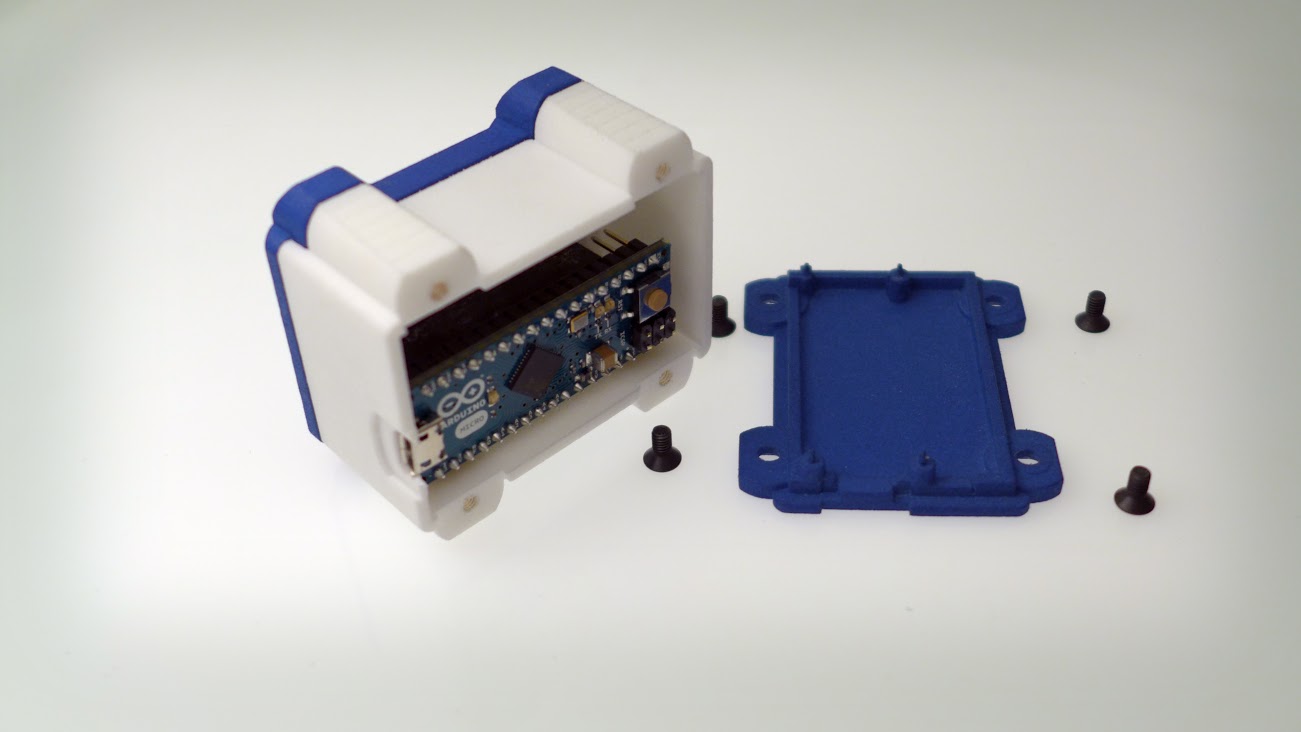
openQCM has Arduino inside at heart

openQCM the open source quartz crystal microbalance project has an Arduino electronic board inside the heart

openQCM is the fully open source quartz crystal microbalance project with an Arduino electronic board inside its heart Continue reading “openQCM has Arduino inside at heart”

Why an Open-Source Quartz Crystal Microbalance ?

I do open source because it’s fun and it works… Companies who work with the kernel community will waste less time and they’ll just work better. Linus Torvalds

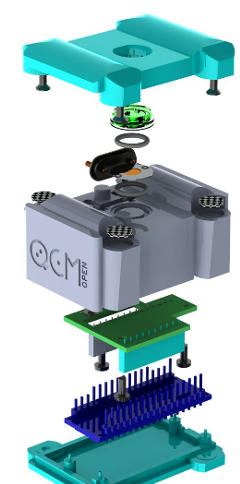
openQCM exploded view

Hello, in a few days, we will launch our first scientific Open Hardware product.
I, therefore, believe it is appropriate, as first post to introduce and explain the reasons why we decided to adopt an “Open-Source” strategy.
My name is Raffaele Battaglia and I am the creator of the openQCM project and the founder of Novaetech Srl, a company that has been operating, for almost 10 years, in the field of applied research and sensors.
Despite being an astrophysicist, involved in the past in theoretical research about Cosmic Background Microwave Radiation, the Ph.D. in aerospace engineering has led me to a crucial turning point in life.
Specifically, I have been involved in the development of systems based on Quartz Crystal Microbalance, designed to detect and study the presence of dust and water vapor in extraterrestrial environments, such as the planet Mars and the 67P / Churyumov-Gerasimenko comet, that in the past weeks has been approached by the ESA Rosetta spacecraft.
After a few years in the world of research, I decided to found a company together with some of my colleagues. Our main goal was to create real business starting from our know-how. Our aim was to design and produce high technology custom systems, and offering specifics problem solving services for the research and for the industry.
We initially worked only in the aerospace sector. Gradually, however, with the acquisition of new expertise, we decided to extend our activities in wider research fields, where was specifically necessary to employ ultra sensitive mass sensors characterized by extreme performances.

And so we have designed and implemented systems for medicine, biology, environment and energy.

Thanks to our activities, we have had the honor to work with leading international institutions and companies as NASA, ESA, Pirelli Labs., Thales etc. We have contributed to the filing of patents for new MEMS technologies and we have published several scientific papers in journals such as Science and Analyst.

But, it has always been our greatest desire to create a specific product, whose technology core could represent our history. A product to be easily accessible to all by maintaining high technology and quality at the same time. A product absolutely Open-Source… and more better Open Hardware.

As matter of fact, we firmly believe that sharing knowledge is the crux of the new future. Only open access could be the basis of a better society.

We are working around several other ideas, but we felt that our first step should allow easy access to a particular research facility. So we decided to develop a new concept Quartz Crystal Microbalance device: openQCM.

Why a Quartz Crystal Microbalance system? QCM are based on the intrinsic property of the quartz crystal: the piezoelectricity. As a consequence the development of analytical devices for microbiology, materials science, pharmaceutics and medicine, can be simpler and potentially cheeper. A device in which
the quality of measurements and related results depend mainly on the intrinsic feature that nature gave to the quartz… only one system for a wide field of applications.
As matter of fact, QCM systems are today widely used in various fields of research and industry. However, it is difficult to gain access to such a technology, in form of a complete HD/SW system, unless investing from a few thousand up to several hundred thousand dollars. But there are many research institutions and small enterprises unable to support high costs for instrumentation resources.

To these reasons, we wanted to start by making available a research tool that everyone can very easily build by yourself, or buy at a very affordable price. The only way to do this is trough the Open Hardware concept.
As happened in Open-Source software, the main advantage of the] Open Hardware strategy is the direct involvement of the community in the improvement and customization of systems and its possible derivatives. An immense added value also for key fields such as research and industry.

We are firmly convinced that high quality research  is not necessarily related to highly expensive proprietary products, characterized by closed-architecture. On the contrary, we believe that the Open Hardware is even better, since collaborative participation produces high-speed and high quality development.