
openQCM Store Talk with us

Quartz crystal microbalance Make the measurable.

From an interaction
to a measurement.
01 / Instruments

Three instruments. One question each.

Same open architecture, same 14 mm quartz sensors, same software lineage. Choose by the measurement your protocol needs.

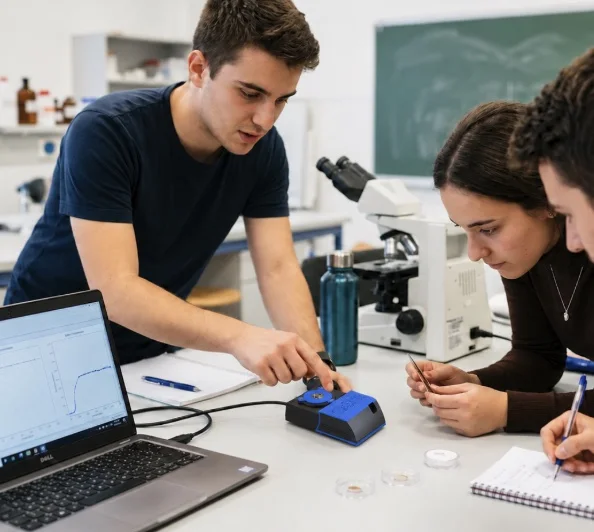
openQCM Wi2 on a teaching bench: three students follow the frequency curve on a laptop

openQCM Wi2

Frequency monitoring · USB

Monitors the resonance frequency at the fundamental. No dissipation, no overtones.

Does my experiment need frequency monitoring only?

Readout
Δf at the fundamental, 1 s gate
Overtones
None
Temperature
Measured in the sensor module, not controlled
Noise
Fundamental only; see the data sheet
Chamber
~50 µl · 5 or 10 MHz crystals
Included
Instrument with sensor module (PMMA window, FKM O-ring), open-source Python software and Windows executable. Quartz sensors and the PTFE window are listed in the store.
Availability
Assembled and tested in Pompeii before shipping; lead time confirmed with the quote.
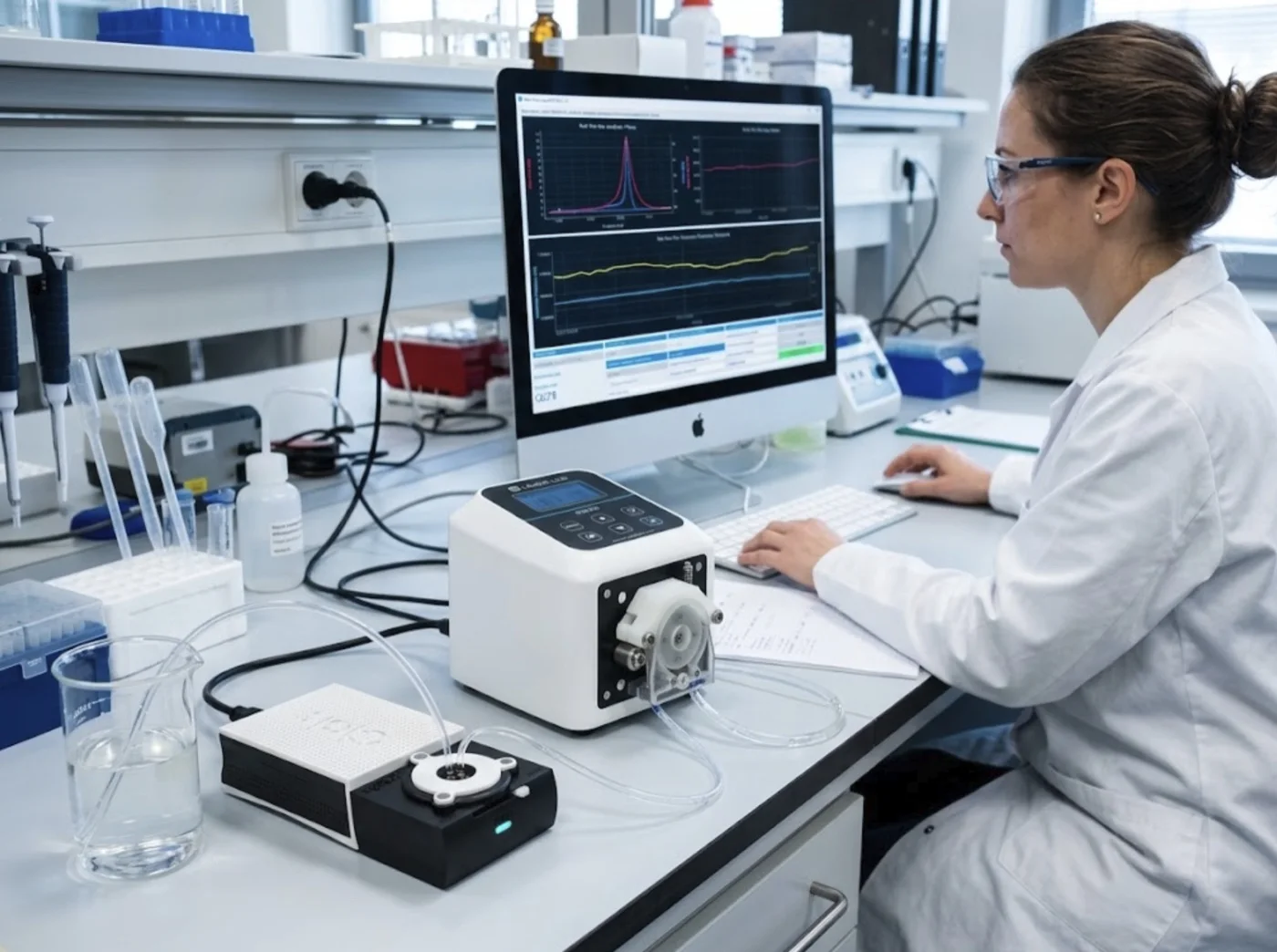
openQCM Q-1 in the lab, connected to a peristaltic pump, with the resonance curve and the frequency trace on the screen

openQCM Q-1

QCM-D · one overtone at a time

Frequency, dissipation and overtone analysis, one selected overtone at a time. No active thermal control.

Do I need dissipation and overtones?

Readout
Δf + ΔD
Overtones
Up to the 9th (5 MHz) or 5th (10 MHz), one at a time
Temperature
Measured in the sensor module, not controlled
Noise
0.1 Hz in air · 2.8 Hz in liquid (fundamental)
Chamber
~50 µl · ~1.0 s per overtone
Included
Instrument with sensor module (PMMA window, FKM O-ring), open-source Python software, CSV data. Quartz sensors, PTFE window and the electrochemistry module are listed in the store.
Availability
Assembled and tested in Pompeii before shipping; lead time confirmed with the quote.
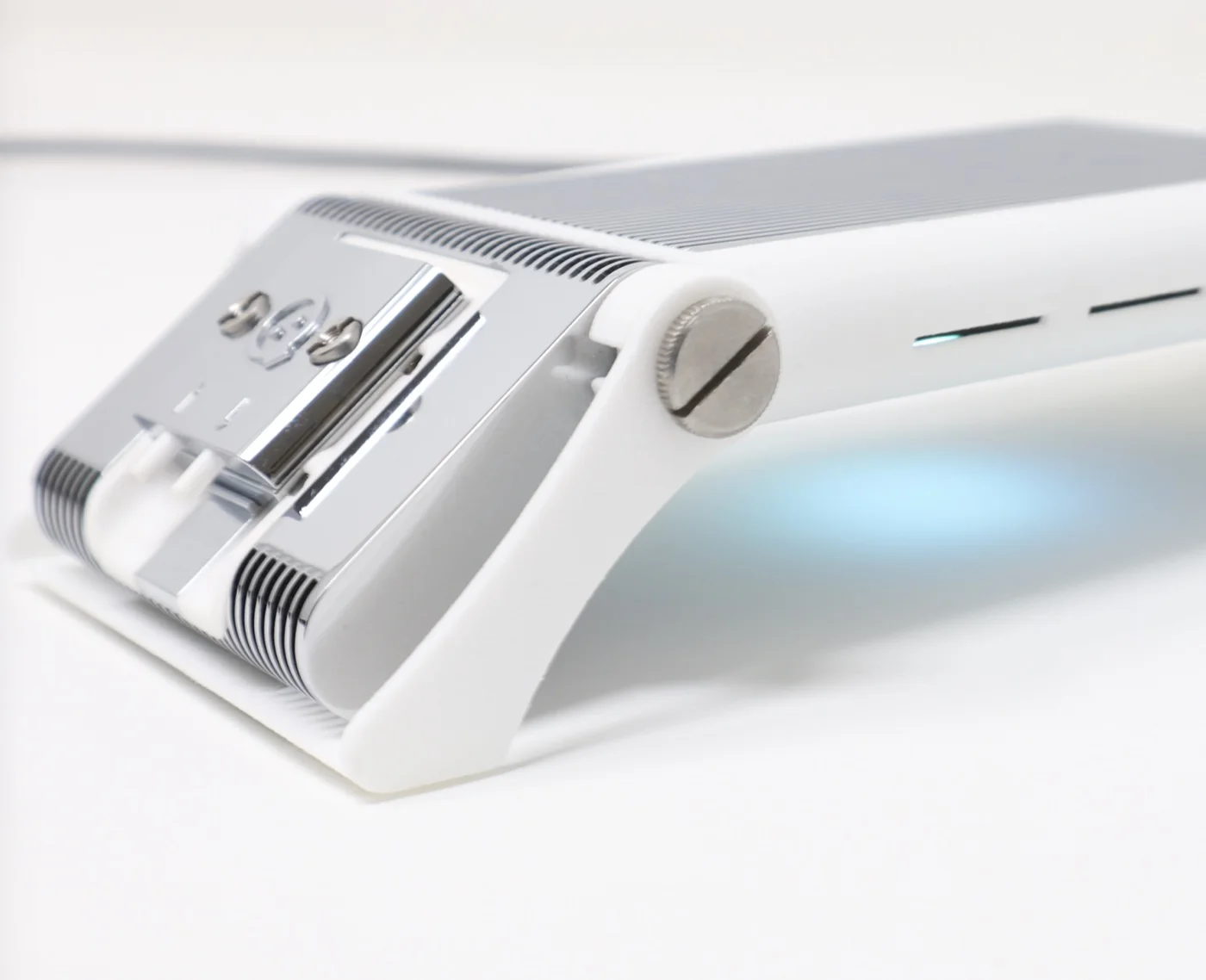
openQCM NEXT, close up: the chrome fluidic module in the white heat sink, the status light on

openQCM NEXT

Multi-overtone QCM-D · thermal control

Frequency, dissipation and every overtone in each cycle, with the cell held at a set temperature.

Does my protocol also need a controlled temperature?

Readout
Δf + ΔD on n = 1, 3, 5, 7, 9
Overtones
All of them in every cycle (~1.4 s per overtone) (9th in beta)
Temperature
Set point 25–45 °C, stable to ±0.01 °C
Noise
0.1 Hz in air · 2.0–2.8 Hz in liquid
Chamber
~50 µl · PTFE core, FKM O-ring
Included
Sold as an R&D kit: instrument with the standard fluidic module, Peltier power adaptor, open-source Python software and Windows executable. Optical and pipetting modules and quartz sensors are listed in the store.
Availability
Assembled and tested in Pompeii before shipping; lead time confirmed with the quote.

Overtone analysis is available on both Q-1 and NEXT: Q-1 sweeps one selected overtone at a time, NEXT sweeps all of them in every cycle, about 1.4 s per overtone. The 9th overtone on NEXT is in beta. Figures come from the instrument data sheets, revision 2026-10: NEXT · Q-1 · Wi2. Embedded and OEM modules (SpaceBug, TWIN, Holder) are on the Devices page.

02 / What you buy

From a scientific interest to a working setup.

An openQCM configuration has four parts. For each one: what comes with the instrument, what is optional, and what you provide.

Instruments

Wi2, Q-1 or NEXT, assembled and tested in Pompeii. NEXT is sold as an R&D kit: an open research instrument for the laboratory, not a certified analyser.

Included
Instrument with its sensor or fluidic module, open-source software and firmware.
You provide
A PC with a USB port; a pump and tubing for flow experiments.
Compare the three

Sensors

5 MHz and 10 MHz AT-cut quartz crystals, 14 mm, wrapped electrode with single-side contact. Gold electrodes as standard; other coatings available or on request.

Optional
Ordered with the instrument or later, from the store.
Note
One crystal per instrument; the same crystals fit Wi2, Q-1 and NEXT.
Sensors in the store

Modules & accessories

Standard, optical and pipetting fluidic modules for NEXT; the electrochemistry module for Q-1; a PTFE window for organic solvents on Wi2 and Q-1.

Optional
Each module is a plug-in accessory listed in the store.
Experimental
The electrochemistry module for NEXT is a prototype.
The NEXT modules

Software & support

Python software, open source, with a Windows executable; CSV data, one file per run, raw sweeps on request. Support comes from the engineers who built the instrument.

Included
Software, firmware, manuals, FAQ and forum.
Direct
Technical support by email; application advice before you buy.
The software
03 / Applications

Start from the experiment.

Four paths that our users have documented most. Each one goes from the question to a configuration, a measurement, a publication and a person to talk to.

Adsorption at interfaces

  1. Question

    How much adsorbs on the surface, how fast, and does it stay when the solution is exchanged?

  2. Configuration

    Q-1 or NEXT with a 5 MHz gold crystal, the standard flow module and a syringe pump in pump-out mode. NEXT if the kinetics need a fixed temperature.

  3. Example measurement

    A real NEXT run: air, water and isopropanol on five overtones

  4. Publication

    Surface-Mounted Metal-Organic Framework for the Adsorption and Sensing of Monoaromatic Pollutants in Water Using Quartz Crystal Microbalance Advanced Materials Technologies · 2025 doi

  5. Technical contact

    Discuss this setup

Films, polymers and coatings

  1. Question

    Is the film rigid or soft, how much does it swell, and how does it respond to humidity or solvent?

  2. Configuration

    NEXT: Δf and ΔD on five overtones with the cell at a set temperature. Spin-coat or deposit the film on the crystal; use the PTFE window with organic solvents.

  3. Example measurement

    A real NEXT run: the overtones of a loaded crystal

  4. Publication

    Postannealing-Driven Optimization of Humidity Response in Densely and Loosely Grafted Polymer Films Gels · 2026 doi

  5. Technical contact

    Discuss this setup

Sensor development

  1. Question

    Does my coating respond to the analyte, how fast, how selectively, and is the response reversible?

  2. Configuration

    Wi2 for frequency-only screening of coated crystals in gas or liquid; Q-1 when dissipation tells a soft coating from a rigid one. Temperature is logged on both.

  3. Example measurement

    The Wi2 data sheet: gate time and noise at the fundamental

  4. Publication

    Evaluation of Linkers’ Influence on Peptide-Based Piezoelectric Biosensors’ Sensitivity to Aldehydes in the Gas Phase International Journal of Molecular Sciences · 2023 doi

  5. Technical contact

    Discuss this setup

Electrochemistry and EQCM

  1. Question

    What mass change goes with the electrode reaction, and how does the layer stiffen or soften with potential?

  2. Configuration

    Q-1 with the electrochemistry module and your potentiostat: the crystal electrode is the working electrode. The EQCM module for NEXT is a prototype.

  3. Example measurement

    The electrochemistry module for Q-1

  4. Publication

    Design and validation of a low-cost open-source impedance based quartz crystal microbalance for electrochemical research HardwareX · 2022 doi

  5. Technical contact

    Discuss this setup

Samples & solvents
Aqueous buffers, gases and most solvents in the PTFE core with an FKM (Viton) O-ring. The PMMA window of Wi2 and Q-1 swells in many organic solvents, ethanol included: use the PTFE window.
Temperature
NEXT holds the cell at a set point between 25 and 45 °C, stable to ±0.01 °C. Wi2 and Q-1 record the temperature of the sensor module but do not control it.
Volume & flow
About 50 µl in the measurement chamber on every instrument. A pump-out configuration is the one we recommend against leaks.
Known limits
One crystal per instrument. Dissipation needs Q-1 or NEXT. Keep the instrument away from motors, phones and other electromagnetic sources during a run.
04 / Evidence

Three studies, read closely.

What was measured, with which instrument, and what the QCM data added to the result. The full bibliography is below, in the atlas, and in the papers index.

Materials Horizons2026

Design of polymer-based CO2-membrane adsorbers for carbon capture

Problem & sample
CO₂ capture by polymer membrane adsorbers. Films of PDMAPAm and PDMAPAm-b-PMMA diblock copolymers, with the block composition varied to find the best uptake.
Instrument & configuration
openQCM Q-1 with coated crystals: the CO₂ uptake of the copolymer films followed as a frequency shift, under dry and humid conditions (details in the paper).
What the QCM data added
The mass uptake kinetics of the films, the data behind a unified model that links the polymerisation kinetics to the adsorption kinetics and lets the capture capacity of a membrane be predicted from the polymer composition.

Emil Pashayev, Prokopios Georgopanosdoi:10.1039/d6mh00641h

Gels2026

Postannealing-Driven Optimization of Humidity Response in Densely and Loosely Grafted Polymer Films

Problem & sample
Humidity sensing with PVA-based copolymers carrying grafted PDMA chains. Spin-coated films of 150–200 nm, annealed at 60, 120 and 180 °C, with two grafting densities.
Instrument & configuration
openQCM NEXT, QCM-D on openQCM sensors: frequency and dissipation of the films as the relative humidity changes, at each annealing temperature.
What the QCM data added
Water uptake and the viscoelastic response of the films, separating the effect of the macromolecular architecture from that of the annealing temperature and pointing to the post-annealing condition that optimises the humidity response.

Katerina Lazarova, Silvia Bozhilova, Martina Docheva, Ketrin Pavlova, Gergana Alexieva, Darinka Christova, Tsvetanka Babevadoi:10.3390/gels12060515

Langmuir2025

Effect of Added Salt and Hydrophobic Comonomer on the Synthesis and Adsorption Behavior of Cationic Sterically-Stabilized Nanoparticles

Problem & sample
Adsorption of cationic sterically stabilised diblock copolymer nanoparticles at the silica/water interface, and how added salt and a hydrophobic comonomer change it.
Instrument & configuration
openQCM NEXT with a silica-coated crystal as the planar silica/water interface; nanoparticle dispersions in 1, 10 and 100 mM KCl.
What the QCM data added
The adsorbed amount and surface coverage at each salt concentration, showing that salt screens the repulsion between particles and strengthens adsorption, and that the hydrophobic comonomer raises the coverage further. SEM confirmed the aggregates seen at 100 mM.

Hubert Buksa, Andi Xie, Derek HH Chan, Oleta Norvilaite, George Sanderson, Rebecca M Corrigan, Steven P Armesdoi:10.1021/acs.langmuir.5c02575

409records in the openQCM bibliography

What is counted: publications that used an openQCM instrument or sensor, or that cite the project, one record per publication. Not citations of a single paper.

  • 323 peer-reviewed articles
  • 45 theses
  • 26 conference papers
  • 15 books, chapters, preprints
Search the index by instrument, topic or year
Institutions in the customer atlas that have published with openQCM, among others
  • The University of Sheffield
  • Helmholtz-Zentrum Hereon
  • Bulgarian Academy of Sciences
  • University of Cambridge
  • CNRS
  • Northwestern University
  • American University of Beirut
  • Lawrence Berkeley National Laboratory
  • Oak Ridge National Laboratory
The customer atlas
05 / Open

Open hardware.
Open possibilities.

Same surfaces.
Bigger questions.

Your data

Every run is a CSV file with time, frequency, dissipation and temperature. Raw sweeps can be saved too. Nothing stays locked in the software.

Inspect the method

Python source and Arduino-based firmware are published. You can read how the resonance is found and how dissipation is computed.

Adapt it

Change the sweep, add a channel, drive the instrument from your own script. Wi2 has an expansion header for a wireless module or a custom board.

Integrate it

USB serial on every instrument. TWIN and SpaceBug put the same core inside your rig, vacuum chamber or payload.

Established
  • Frequency on Wi2, Q-1 and NEXT
  • Dissipation on Q-1 and NEXT
  • Overtones to the 7th on NEXT, every cycle; one at a time to the 9th on Q-1
  • Thermal control at ±0.01 °C on NEXT
  • Standard, optical and pipetting modules for NEXT; electrochemistry module for Q-1
Experimental
  • 9th overtone on NEXT (beta)
  • Electrochemistry module for NEXT (prototype)
  • Wireless on Wi2: the header is there, the radio module is yours
06 / Research in the open

Measured around the world.

409
papers in the bibliography
56
countries
678
institutions and companies
In the lab in
US · DE · IT · GB · FR · CA · KR · TR · JP · BR · IN · ES · PL · CN · ID · IL · NL · CH · AU · TH · CZ · PT · HK · BG · SE · DK · PH · SG · IE · MX · TW · HU · SK · NO · AR · NZ · BD · GR · SI · EG · AE · RU · MY · FI · RO · AT · BE · LU · HR · IQ · LB · MA · SA · PK · LT · KW
Every light is a laboratory · drag to turn
Voices from the bench

Excellent technical support on the QCM-D studies.

Prof. Steven P. ArmesDepartment of Chemistry · University of SheffieldThe paper
07 / Talk with us

Three doors, one team.

Chat, forum and email already exist. This is who answers what, and what you get back. First contact needs only your email, the experimental goal and a line about the sample.

Before you buy

Evaluate an experiment

Tell us the sample, the medium and the quantity you need to follow. An engineer checks the compatibility and proposes a configuration.

You get back
Whether QCM fits, which instrument and modules, and the next step: a demo, a quote or a different technique.
Discuss your experiment
After you buy

Solve a problem

Noise, drift, a crystal that does not lock, software that does not connect. Send the instrument, the crystal, the medium and a data file if you have one.

You get back
A confirmation of the request, the first checks to run, and a diagnosis from the engineers who built the instrument.
Get technical support
Alongside the project

Contribute

A paper to add to the index, a modification that worked, a module you wish existed. Open hardware grows from the bench.

You get back
The status of your proposal and a note when it lands in a release, a sheet or the papers index.
Share results or suggest an improvement

After you send: a summary of your request on screen and a reply within one business day, from Pompeii (CET).

Developed with researchers
  • The bridge of NEXT

    The heat-sink design and the plug-in fluidic module came out of feedback gathered from the scientific community on the earlier instruments.

  • Pipetting module

    An open PTFE cover with direct access to the sensor, for labs that pipette the sample instead of pumping it.

  • Optical module

    A silica window over the crystal, so that spectroscopy and Raman can look at the same surface the QCM weighs.

  • Python software for Q-1

    The Java software of the early Q-1 units was replaced by the open Python application, with a migration path kept in the FAQ.

Colophon

Explore. Measure.
Publish. Repeat.

openQCM is a brand of Novaetech S.r.l. · Open hardware since 2014 · © 2026 · Cookies & Privacy Policy · Images CC BY-NC-SA 4.0, commercial use: ask us