
Scientific Paper
Percolation-Driven β-Relaxation Enables Resonant Acceleration of Crystallization in Amorphous Phase-Change Materials
Abstract
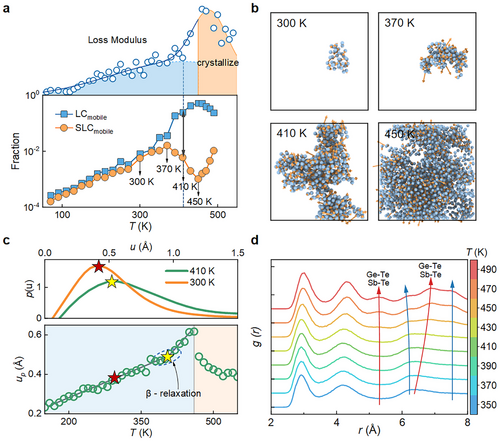
ABSTRACT Amorphous phase-change materials enable fast and reversible switching in optical and electronic devices, yet crystallization kinetics are still controlled primarily through empirical thermal protocols. Here we identify a microscopic picture governing crystallization in the prototypical phase-change material Ge2Sb2Te5, in which crystallization pathways are organized by the percolation of mobile atomic networks associated with β-relaxation. We show that this percolation transition distinguishes the dominance of diffusion-driven and diffusionless nucleation and growth during crystallization processes. We further demonstrate that frequency-selected ultrasonic excitation, applied in conjunction with heating, accelerates crystallization by enhancing percolation-mediated atomic dynamics. This acceleration is maximized near the β-relaxation frequency, consistent with resonant excitation of mobile atoms. Our results establish a direct link between glassy relaxation, atomic-scale percolation, and crystallization, and introduce a new route to modulating phase-change kinetics through targeted excitation of fundamental glassy dynamics.
Abstract reproduced from the published article under its CC BY 4.0 licence; copyright remains with the authors.
Related work.
- Nanostructure-Enabled Apparent Slip through Dynamic Hydration Reorganization 2026
- Evaluation of Dynamic Viscosity in the 10 MHz Range Using a General-Purpose Quartz Crystal Microbalance 2022
- Solvent effects of N,N-dimethylformamide and methanol on mass spectrometry imaging by tapping-mode scanning probe electrospray ionization 2023
- Rheology of the Electric Double Layer in Electrolyte Solutions 2020
- QCM sensörlerinin partikül madde konsantrasyonunu ölçmek için geliştirilmesi 2024
- Effects of model membranes on lysozyme amyloid aggregation 2023
New openQCM papers, by email.
A selection of new publications measured with openQCM, with software releases and application notes. A few emails a year.
Browse all papers.
Hundreds of peer-reviewed publications cite openQCM. Search full-text and filter by instrument, year, journal or topic.