
Electrochemistry module for Q-1 · Electrochemical QCM (EQCM)Mass meets charge.
The electrochemistry module turns the openQCM Q-1 into an EQCM: the gold electrode of the crystal becomes the working electrode of your potentiostat. Every coulomb that flows and every nanogram that lands are measured on the same surface, at the same time. The current flows over the whole wetted electrode while the crystal weighs mainly the central region where the two electrodes overlap: compare mass and charge per unit area, assuming uniform deposition.
I —Δf —
- cell volume
- ~15ml
- ports for RE and CE
- 2 × 6.2mm
- weight
- ~90g
- size
- 6 × 7 × 6cm
Two measurements, one electrode.
The larger gold electrode of the 14 mm crystal faces the electrolyte and connects, through a 2 mm banana socket, to the working-electrode lead of your potentiostat. Reference and counter electrodes enter through the PTFE cover. The Q-1 keeps measuring frequency and dissipation, one overtone at a time, while the potentiostat runs the electrochemistry. The two circuits are not galvanically isolated: the module connects the crystal directly between the analyser's QCM-IN and QCM-OUT, so both crystal electrodes are tied to the instrument's ground through about 50 Ω. Run the potentiostat floating, or with one shared ground point, to avoid ground loops.
- WE · the crystal's gold electrode, 2 mm banana socket
- RE · reference electrode, through a 6.2 mm port
- CE · counter electrode, through a 6.2 mm port
Five parts, one seal at a time.
A PTFE reservoir with three wings at 120° that stop it from rotating; a transparent quartz cylinder you can look through; a bayonet fixing ring; a PTFE cover with two 6.2 mm ports for reference and counter electrodes, two small auxiliary ports for filling and flow, and adapters for 4 and 6 mm probes. FKM (Viton) O-rings seal reservoir and cylinder.
- PTFE cover2 × 6.2 mm ports for RE and CE, 2 auxiliary ports; adapters for 4 and 6 mm probes
- Bayonet fixing ringsmall turns to engage, then counterclockwise to moderate resistance: never fully tight
- Quartz cylindertransparent: watch the electrode, the bubbles, the level
- PTFE reservoirthree wings at 120° lock it in the holder; FKM O-rings seal sensor and cylinder
- Crystal14 mm, larger gold electrode up: it becomes the working electrode
Fill it up to the ports.
Fill the cell completely, up to the electrode ports: a free air–liquid surface adds noise to the baseline, and so do bubbles, evaporation and changes of temperature. Degassed electrolyte, slow filling and a slight positive pressure help.
What people measure with it.
The module contains no potentiostat: it is designed to work with most commercial ones. Cyclic voltammetry, chronoamperometry and impedance spectroscopy run on the potentiostat, while the QCM follows the mass on the electrode.
- 01Energy storageion insertion and extraction, supercapacitors
- 02Corrosionrates and inhibitors, in situ
- 03Biosensorslabel-free immunosensors, protein–surface interactions
- 04Electroactive materialsgrowth of conducting polymers
- 05Surface modificationself-assembled monolayers, layer-by-layer films
- 06Electrodeposition, and impedance studies combined with QCM-D
No acetone, ever.
Clean the PTFE parts and the quartz cylinder with deionized water or a mild detergent, isopropyl alcohol for stubborn residues; an ultrasonic bath in IPA, two 5-minute cycles, is an option. Never acetone or aggressive organic solvents. Handle the quartz cylinder with gloves and safety glasses.
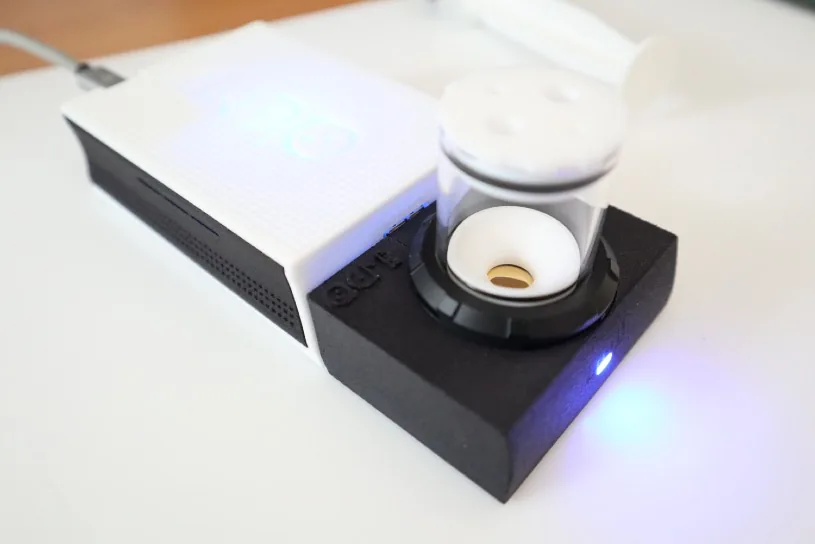
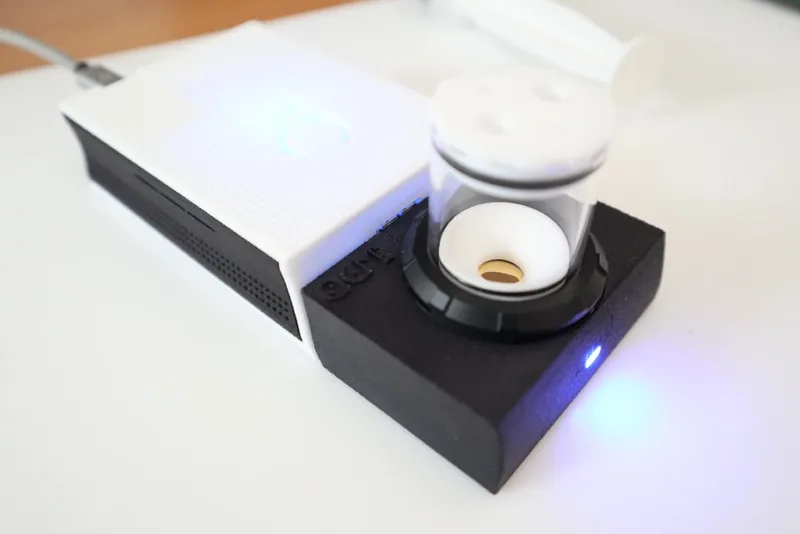
Swap the module, keep the Q-1.
The electrochemistry module takes the place of the standard sensor module of the Q-1, on the same mounting interface, and connects to the central unit through a USB3 connector; a blue LED on the module confirms the connection. Connect it only to the Q-1, never directly to a computer. Reference and counter electrodes enter through the fittings of the PTFE cover; the working electrode connects through a banana plug.
The data sheet.
From the official manual. Where two documents disagree, the figure is left out until it is confirmed.
Cell
- Volume
- ~15 ml
- Materials
- PTFE reservoir and cover, quartz cylinder, FKM (Viton) O-rings, anodized aluminium sensor holder, PLA case
- Ports
- 2 × 6.2 mm (RE, CE) + 2 auxiliary; adapters for 4 and 6 mm probes
- Size
- 6 × 7 × 6 cm
- Weight
- ~90 g
Electrochemistry
- Working electrode
- Larger gold electrode of the crystal, 2 mm banana socket
- Potentiostat
- External, most commercial models (CV, CA, EIS)
- Crystals
- 5 and 10 MHz, 14 mm, wrapped electrode
Compatibility
- Instrument
- openQCM Q-1: replaces the standard sensor module on the same mounting
- Connection
- USB 3 connectors to the Q-1 central unit only, never to a PC
News on Electrochemistry module for Q-1, by email.
Firmware and software releases, new modules and accessories, application notes. A few emails a year.
Add electrochemistry to your Q-1.
The module mounts on your Q-1 and pairs with the potentiostat you already have. Ask us about probes and custom covers.
Electrochemistry module for Q-1 (R&D kit): €1,699 excl. VAT, on the store