
Scientific Paper
Design of polymer-based CO2-membrane adsorbers for carbon capture
Abstract
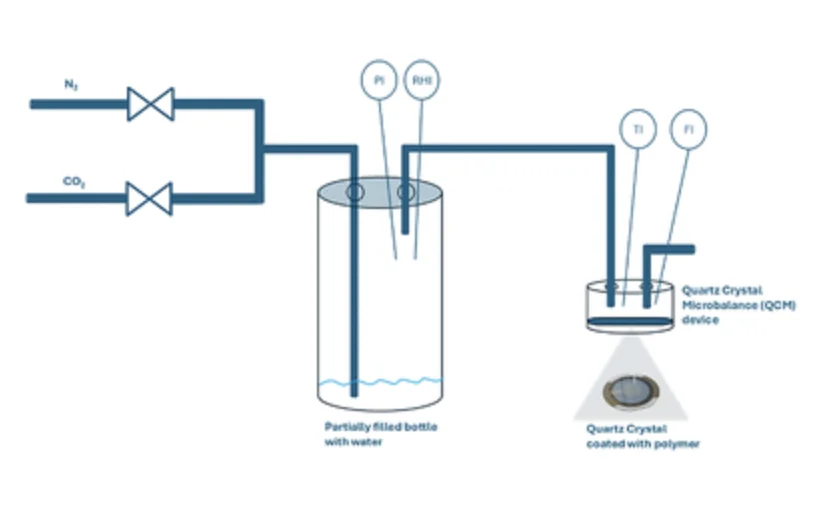
This study focuses on the CO2 capture performance of poly(N,N-dimethylaminopropyl acrylamide) (PDMAPAm) and poly(N-[3-(dimethylamino)propyl]-acrylamide)-b-poly(methyl methacrylate) (PDMAPAm-b-PMMA) diblock copolymers for fabrication of CO2-responsive membrane adsorbers. By systematically varying the block composition of the diblock copolymer PDMAPAm-b-PMMA, optimal compositions for maximizing CO2 adsorption capacity are identified. The adsorption mechanisms were characterized under both dry and humid conditions, revealing distinct physisorption and chemisorption pathways. The first major novelty of this work is the creation of a unified kinetic model that, for the first time, integrates polymerization kinetics with adsorption kinetics, allowing the CO2 uptake capacity of membrane adsorbers to be directly predicted from the underlying polymer properties. A second key innovation is the use of this unified model to rationally design and fabricate a polymer membrane adsorber that achieves a CO2 uptake capacity of 6 mmol g−1, substantially exceeding the performance of commercially available polymer-based sorbents.
Related work.
- Rapid Screening of Vapor Uptake by Ultra-Thin Polymer Films Using Surface Plasmon Resonance and Quartz Crystal Microbalance with Dissipation Monitoring 2025
- MoO3 Coated Quartz Crystal Microbalance as a Room Temperature Ammonia Sensing Platform 2025
- Chitosan/Sn@C composite nanofiber coatings for QCM-based humidity sensing 2026
- A QCM-Based Device for Neurodegenerative Diseases Detection in Human Perspiration 2024
- Electrophoresis and Quartz Crystal Microbalance Instrumentation to Sense Nanoplastics in Water 2024
- Development of gold nanospikes-modified quartz crystal microbalance biosensor for prostate specific antigen detection 2024
Browse all papers.
Hundreds of peer-reviewed publications cite openQCM. Search full-text and filter by instrument, year, journal or topic.