
openQCM Store Talk with us
← The instrument familyHardware monograph / No. 01openQCM Wi2
Benchtop · frequency QCM · USB-powered, wireless-ready

openQCM Wi2 · Compact USB quartz crystal microbalanceCount every cycle.

openQCM Wi2 is the frequency QCM in its plainest form: a Pierce oscillator keeps the crystal ringing, a microcontroller counts its cycles for one second, and that count is the measurement. Small enough for one hand, simple enough for a classroom, open down to the last screw.

Fig. 1 · The one-second countIllustration: an ideal rigid film
Cycles counted in one gate10 000 000= frequency in Hz
Crystal

Δf 0 HzSauerbrey 4.42 ng·cm⁻² per Hz

weight
43g
main dimensions
66 × 50 × 26mm
typical gate time
1s
measurement chamber
~50µl
The principle

An oscillator, not a sweep.

A Pierce oscillator built on an SN74LVC1GX04 inverter locks onto the crystal's fundamental resonance and follows it on its own. The microcontroller counts the edges of that signal over a fixed gate, typically one second. What comes out is the resonance frequency, with the crystal temperature from an MCP9808 sensor pressed against it. Wi2 measures frequency only, at the fundamental: for dissipation and overtones, see Q-1 and NEXT.

  1. 01Quartz crystal14 mm, 5 or 10 MHz, rests on two pogo pins
  2. 02Pierce oscillatorSN74LVC1GX04: keeps the crystal at resonance
  3. 03Square waveone edge per oscillation
  4. 04Hardware counteredges counted over a 1 s gate
  5. 05USB to your computerfrequency and temperature, saved as text
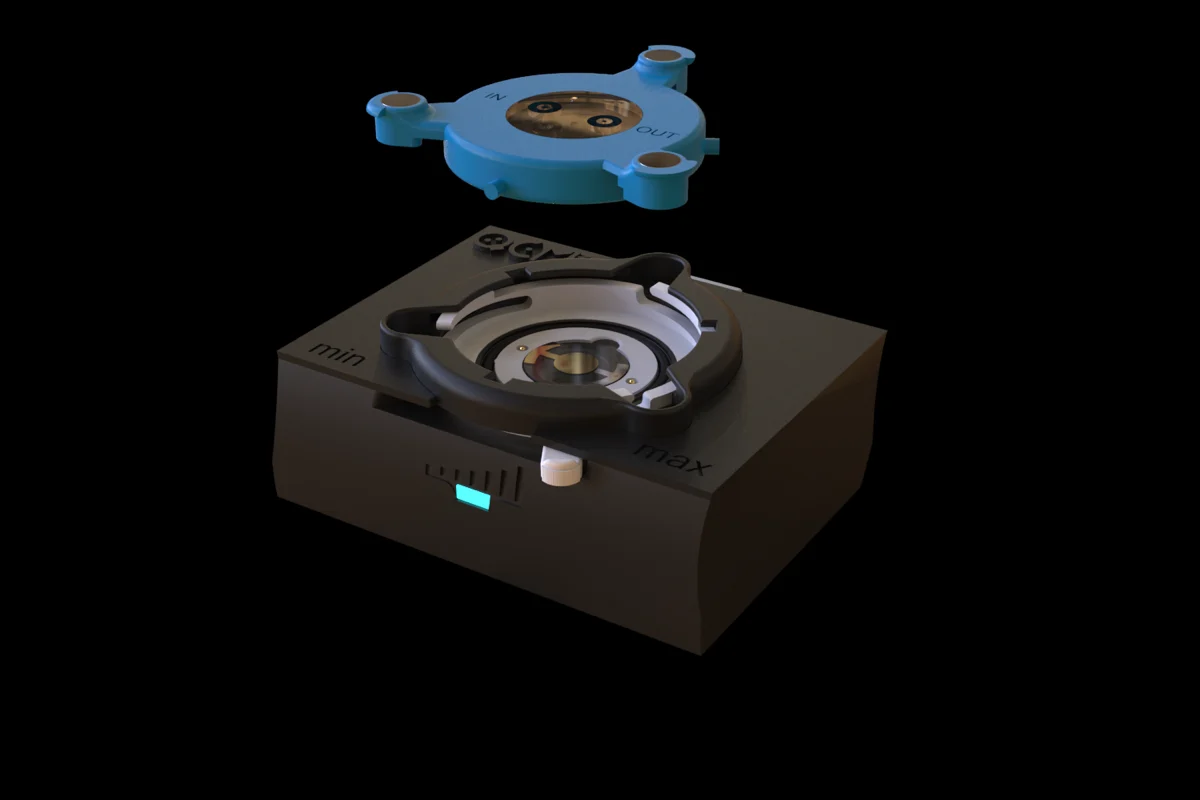
The Wi2 sensor module with the lever and the fluidic cover
The sensor module

Pogo pins, a lever and a magnet.

The 14 mm wrapped-electrode crystal rests on two pogo pins, contact side down. A lever sets the O-ring pressure finely, and a small magnet keeps the temperature sensor against the crystal. The cell holds about 50 µl; its only wetted parts are the window (PMMA or PTFE) and an FKM (Viton) O-ring.

  1. Open Lift the fluidic cover off the module.
  2. Place Lay the crystal contact side down, its back electrodes on the pogo pins.
  3. Close Slide the cover in with the lever on “min”, then turn the lever to seal.
  4. Check Draw water towards the cell with a syringe and stop before it enters: if the level stays still, the cell is sealed.
Open hardware

Eight printed parts and one board.

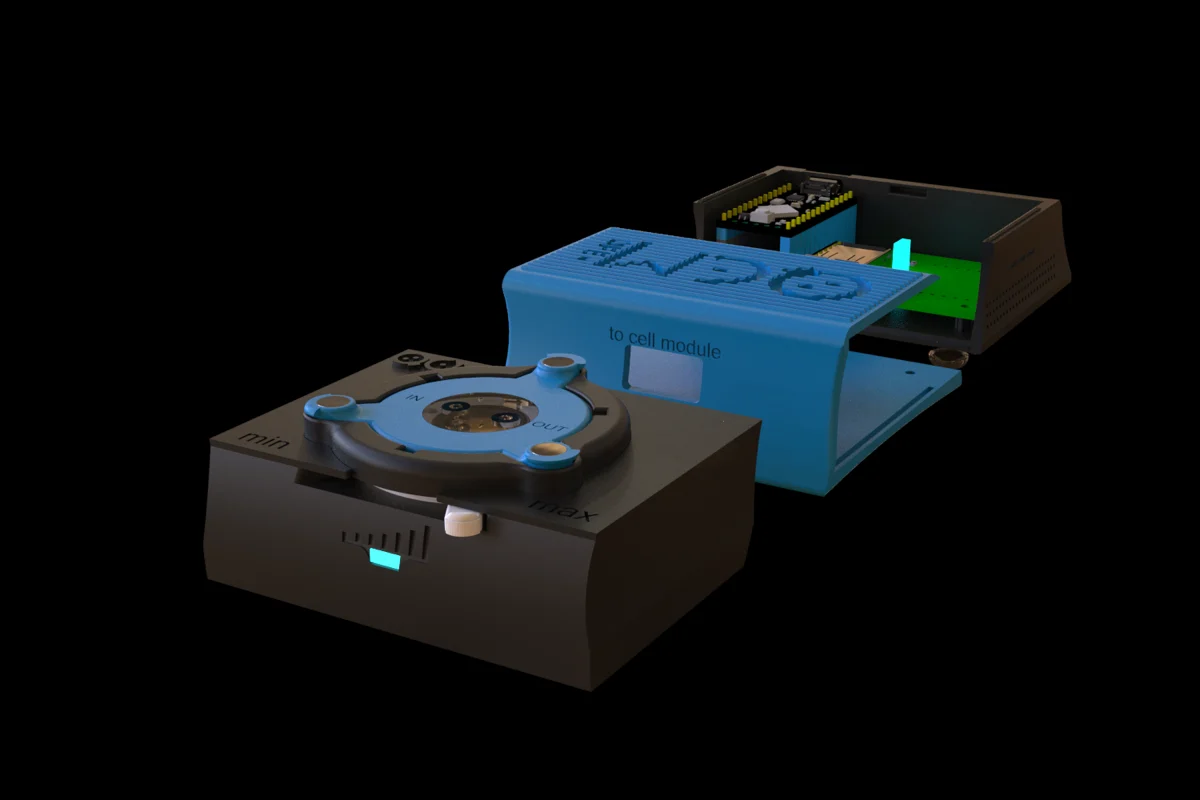
The case is eight SLS-printed nylon PA2200 parts and a CNC-cut window; the main board is a two-layer 59.9 × 36.8 mm PCB with a Teensy microcontroller. The 45-page assembly manual goes through every step, from cutting the O-ring that cradles the crystal to the final leak test.

Exploded view of the Wi2: printed case parts, main board and sensor module
Connectivity

USB today, wireless when you want it.

Power and data travel on one micro-USB cable at 5 V. Expansion headers on the board take a Wi-Fi module or a PCB of your own: Wi2 is wireless-ready rather than wireless out of the box. The software tells devices apart by their port, so several Wi2 can run on one computer, a whole bench of them in a teaching lab.

Validation

What every unit has to pass.

Each assembled unit is tested with a 10 MHz AT-cut crystal, at least 30 minutes in air and 35 minutes in static deionized water, in a 20–30 °C room. Acceptance: frequency standard deviation ≤ 1.0 Hz in air and ≤ 1.5 Hz in liquid, crystal temperature stable within ±0.1 °C, equilibrium in about 10 minutes in air and 20 in liquid.

Acceptance test, 10 MHz crystalAirStatic liquid
Frequency standard deviation≤ 1.0 Hz≤ 1.5 Hz
Crystal temperature stability± 0.1 °C± 0.1 °C
Typical equilibrium time~10 min~20 min
Room temperature20–30 °C20–30 °C
Specifications

The data sheet.

From the official manual. Where two documents disagree, the figure is left out until it is confirmed.

Sensor

Crystals
5 and 10 MHz, 14 mm, wrapped electrode (single-side contact)
Chamber
~50 µl
Wetted parts
PMMA or PTFE window, FKM (Viton) O-ring

Measurement

Quantity
Frequency, at the fundamental
Method
Pierce oscillator (SN74LVC1GX04) and hardware frequency counter
Gate
Typically 1 s
Temperature
MCP9808 against the crystal, ±0.25 °C typical
Dissipation
No (see Q-1 and NEXT)

Build

Case
Nylon PA2200, SLS-printed
Dimensions
66 × 50 × 26 mm
Weight
43 g
Power
USB, 5 V
Wireless
Expansion header for a Wi-Fi module or custom PCB

Software

Licence
Open source
Data
Frequency and temperature in real time, saved to text files
Systems
Windows, macOS, Linux
In the literature

Wi2, in the papers.

Recent publications where the Wi2 was the measuring instrument, from the openQCM bibliography.

Talk with us

Start counting.

Wi2 ships from Pompeii, Italy, ready to measure, or build it yourself from the open files.

Colophon

Explore. Measure.
Publish. Repeat.

openQCM is a brand of Novaetech S.r.l. · Open hardware since 2014 · © 2026 · Cookies & Privacy Policy · Images CC BY-NC-SA 4.0, commercial use: ask us