
Scientific Paper
Unraveling the liquid gliding on vibrating solid liquid interfaces with dynamic nanoslip enactment
Abstract
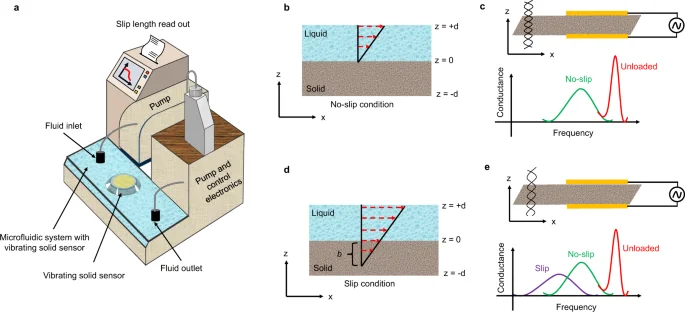
Slip length describes the classical no-slip boundary condition violation of Newtonian fluid mechanics, where fluids glide on the solid surfaces. Here, we propose a new analytical model validated by experiments for characterization of the liquid slip using vibrating solid surfaces. Essentially, we use a microfluidic system integrated with quartz crystal microbalance (QCM) to investigate the relationship between the slip and the mechanical response of a vibrating solid for a moving fluid. We discover a liquid slip that emerges especially at high flow rates, which is independent of the surface wetting condition, having significant contributions to the changes in resonant frequency of the vibrating solid and energy dissipation on its surface. Overall, our work will lead to consideration of ‘missing slip’ in the vibrating solid-liquid systems such as the QCM-based biosensing where traditionally frequency changes are interpreted exclusively with mass change on the sensor surface, irrespective of the flow conditions.
Related work.
- Rapid Screening of Vapor Uptake by Ultra-Thin Polymer Films Using Surface Plasmon Resonance and Quartz Crystal Microbalance with Dissipation Monitoring 2025
- MoO3 Coated Quartz Crystal Microbalance as a Room Temperature Ammonia Sensing Platform 2025
- Chitosan/Sn@C composite nanofiber coatings for QCM-based humidity sensing 2026
- A QCM-Based Device for Neurodegenerative Diseases Detection in Human Perspiration 2024
- Electrophoresis and Quartz Crystal Microbalance Instrumentation to Sense Nanoplastics in Water 2024
- Development of gold nanospikes-modified quartz crystal microbalance biosensor for prostate specific antigen detection 2024
Browse all papers.
Hundreds of peer-reviewed publications cite openQCM. Search full-text and filter by instrument, year, journal or topic.