
Scientific Paper
Postannealing-Driven Optimization of Humidity Response in Densely and Loosely Grafted Polymer Films
Abstract
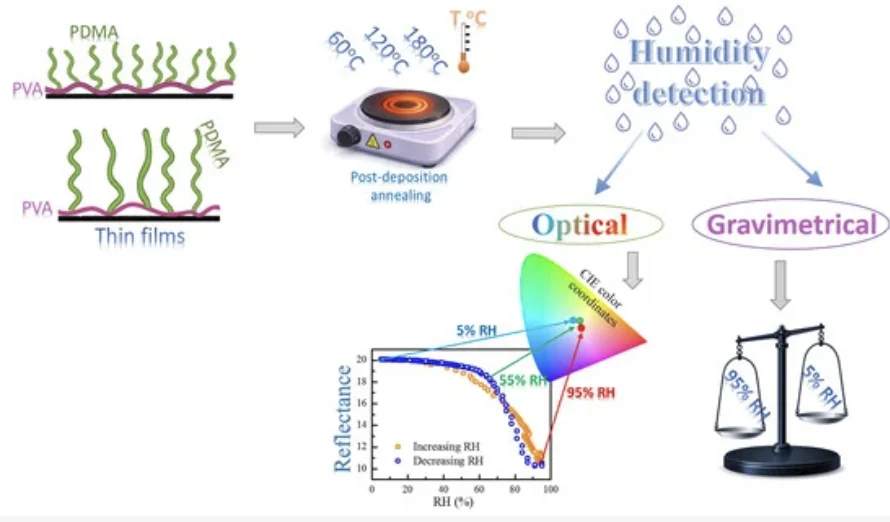
Thermal annealing improves the mechanical, structural, and electrical properties of polymer thin films, promoting processes like residual solvents and stress removal, as well as the crystallization and densification of the gel layer. The effects are strongly dependent on the annealing temperature, where optimal temperatures enhance film performance, while excessive thermal exposure may induce negative outcomes like amorphous structural transitions, increased roughness, and defect formation. In this work, thin films of two humidity-sensitive poly(vinyl alcohol) (PVA)-based copolymers with grafted poly(N,N-dimethylacrylamide) (PDMA) chains were investigated. The polymers differ in grafting density and chain length, enabling the assessment of macromolecular architecture’s effects. Spin-coated films with 150–200 nm thickness were annealed at three temperatures: 60 °C, 120 °C, and 180 °C. By using UV-VIS-NIR spectroscopy and the quartz crystal microbalance method, a comprehensive characterization of temperature- and humidity-induced changes in swelling, hysteresis, sensitivity, detection resolution, and water uptake is performed, elucidating the role of the macromolecular architecture on the post-deposition annealing modification of gel film properties and its humidity response. High-performance humidity sensing with a resolution of 0.8% RH is achieved through the optimization of the interplay between the macromolecular architecture and annealing temperature. In addition, the study highlights and explores the potential of these films for optical color-based moisture detection.
Related work.
- Rapid Screening of Vapor Uptake by Ultra-Thin Polymer Films Using Surface Plasmon Resonance and Quartz Crystal Microbalance with Dissipation Monitoring 2025
- MoO3 Coated Quartz Crystal Microbalance as a Room Temperature Ammonia Sensing Platform 2025
- Chitosan/Sn@C composite nanofiber coatings for QCM-based humidity sensing 2026
- A QCM-Based Device for Neurodegenerative Diseases Detection in Human Perspiration 2024
- Electrophoresis and Quartz Crystal Microbalance Instrumentation to Sense Nanoplastics in Water 2024
- Development of gold nanospikes-modified quartz crystal microbalance biosensor for prostate specific antigen detection 2024
Browse all papers.
Hundreds of peer-reviewed publications cite openQCM. Search full-text and filter by instrument, year, journal or topic.