
openQCM Q-1Frequency and dissipation, live.
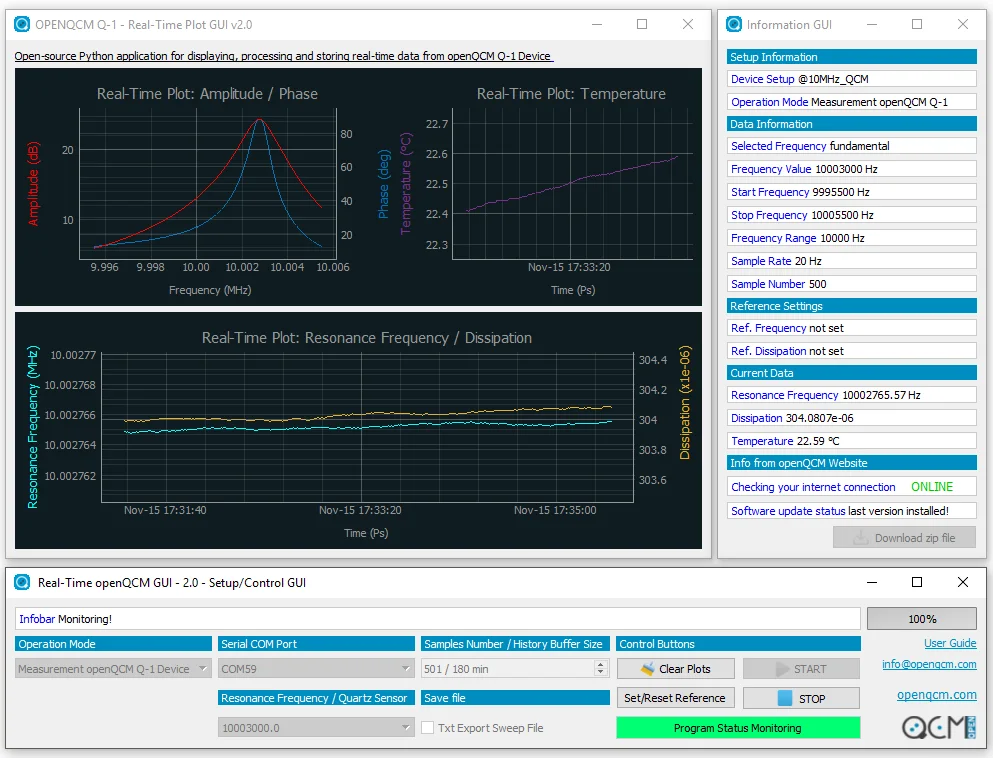
The openQCM Q-1 software monitors frequency and dissipation live, in an open-source Python application — easy to modify and develop for custom scientific applications.
- Instrument
- openQCM Q-1
- Sheet
- 05 / 06
- Title
- Software
- Drawn
- openQCM · Pompeii
Programmed in Arduino.
The Teensy development board is fully compatible with the Arduino programming language and environment. Take advantage of the simplicity of coding and the endless resources shared by the community for programming your scientific device. The Teensy drives the AD9851 sweep and reads the AD8302 gain and phase through its ADC (13-bit effective resolution over 3.3 V). Firmware is uploaded with the Arduino IDE and Teensyduino.
How to install the software
# 1. Unzip openQCM_Q-1_py_v2.1.zip; install Anaconda 3 for Python 3.7conda install pyqtgraph pyserialpython -m pip install --upgrade pippython -m pip install --upgrade h5pypip install progressbar# 2. From the OPENQCM folderpython -m openQCM
What it saves
- Data file
- CSV, one per run: [timestamp]_[overtone].csv in logged_data
- Columns
- Date, Time, Relative time (s), Resonance frequency, Dissipation, Temperature
- Raw sweeps (optional)
- sweep_[overtone]_[n].txt: frequency, amplitude (dB), phase (deg)
- Calibration
- Once per crystal: ~1.5 min, peaks and baseline
Software, firmware, documentation
Files served from openqcm.com and the vendors' sites. Open source: see the licence inside each package.
Know when a new version is out.
New openQCM software and firmware releases, with what changed, plus the occasional application note. A few emails a year.