
Scientific Paper
Piezoelectric biosensor with dissipation monitoring enables the analysis of bacterial lytic agent activity
Abstract
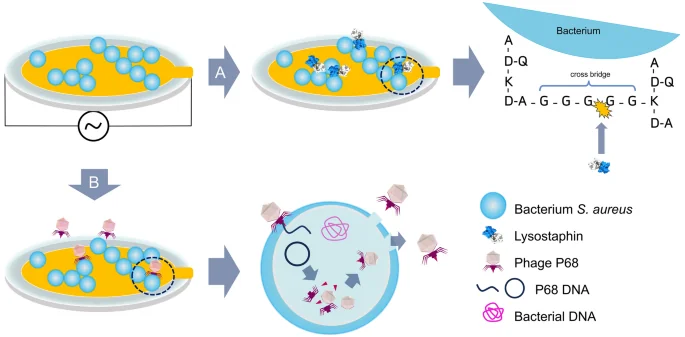
Antibiotic-resistant strains of Staphylococcus aureus pose a significant threat in healthcare, demanding urgent therapeutic solutions. Combining bacteriophages with conventional antibiotics, an innovative approach termed phage-antibiotic synergy, presents a promising treatment avenue. However, to enable new treatment strategies, there is a pressing need for methods to assess their efficacy reliably and rapidly. Here, we introduce a novel approach for real-time monitoring of pathogen lysis dynamics employing the piezoelectric quartz crystal microbalance (QCM) with dissipation (QCM-D) technique. The sensor, a QCM chip modified with the bacterium S. aureus RN4220 ΔtarM, was utilized to monitor the activity of the enzyme lysostaphin and the phage P68 as model lytic agents. Unlike conventional QCM solely measuring resonance frequency changes, our study demonstrates that dissipation monitoring enables differentiation of bacterial growth and lysis caused by cell-attached lytic agents. Compared to reference turbidimetry measurements, our results reveal distinct alterations in the growth curve of the bacteria adhered to the sensor, characterized by a delayed lag phase. Furthermore, the dissipation signal analysis facilitated the precise real-time monitoring of phage-mediated lysis. Finally, the QCM-D biosensor was employed to evaluate the synergistic effect of subinhibitory concentrations of the antibiotic amoxicillin with the bacteriophage P68, enabling monitoring of the lysis of P68-resistant wild-type strain S. aureus RN4220. Our findings suggest that this synergy also impedes the formation of bacterial aggregates, the precursors of biofilm formation. Overall, this method brings new insights into phage-antibiotic synergy, underpinning it as a promising strategy against antibiotic-resistant bacterial strains with broad implications for treatment and prevention.
Related work.
- Rapid Screening of Vapor Uptake by Ultra-Thin Polymer Films Using Surface Plasmon Resonance and Quartz Crystal Microbalance with Dissipation Monitoring 2025
- MoO3 Coated Quartz Crystal Microbalance as a Room Temperature Ammonia Sensing Platform 2025
- Chitosan/Sn@C composite nanofiber coatings for QCM-based humidity sensing 2026
- A QCM-Based Device for Neurodegenerative Diseases Detection in Human Perspiration 2024
- Electrophoresis and Quartz Crystal Microbalance Instrumentation to Sense Nanoplastics in Water 2024
- Development of gold nanospikes-modified quartz crystal microbalance biosensor for prostate specific antigen detection 2024
Browse all papers.
Hundreds of peer-reviewed publications cite openQCM. Search full-text and filter by instrument, year, journal or topic.