
openQCM NEXTMeasure the crystal, nothing else.
Just like the Q-1, the core of the openQCM NEXT electronics is a network analyzer. It passively interrogates the quartz sensor by sweeping around its resonance frequency — characterising the crystal in isolation, free of external circuitry.
- Instrument
- openQCM NEXT
- Sheet
- 04 / 06
- Title
- Electronics
- Drawn
- openQCM · Pompeii
The signal path
- U1AD9851 DDSsynthesises the drive, step by step across each overtone
- U2Quartz crystalin the fluidic module, held at temperature
- U3AD8302gain and phase across the crystal
- U4Teensy 4.0ARM Cortex-M7 at 600 MHz: ADC, sweep control
- U5USBraw curves to the Python software
Gain, phase, and nothing in between.
The actuation signal is produced by the AD9851 DDS/DAC frequency synthesizer, and the resulting output is assessed by the AD8302 gain-and-phase detector — measuring both the gain (magnitude ratio) across the quartz crystal and the phase difference between actuation and output signals.
Analyzing the gain curve characterises the sensor, allowing simultaneous measurement of resonance frequency and quality factor. The key advantage of this scheme is its ability to measure quartz parameters in isolation, eliminating the influence of external circuitry.

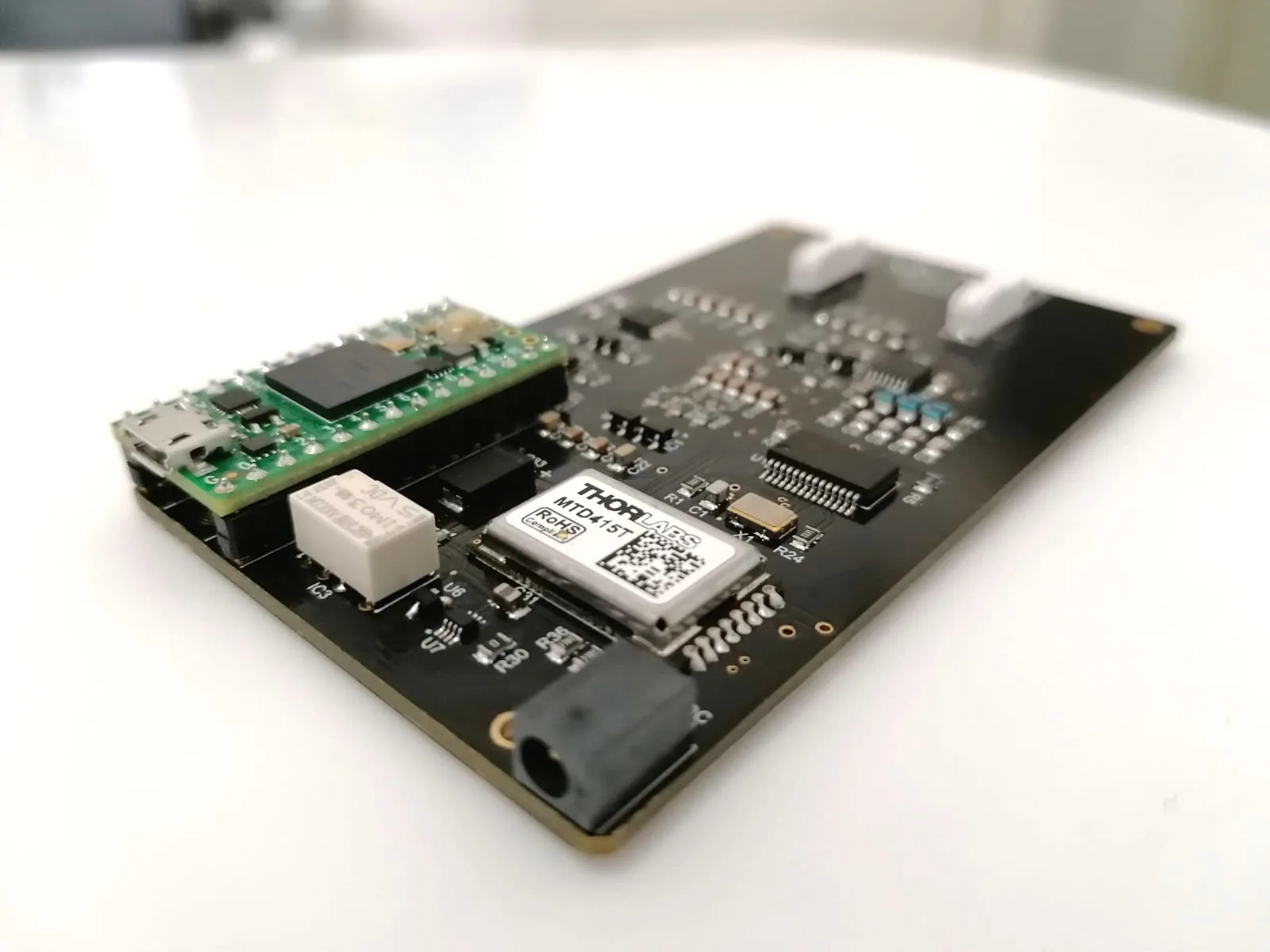
Teensy 4.0, inside its heart.
openQCM NEXT operates with the Teensy 4.0, developed by Paul Stoffregen, built around an ARM Cortex-M7. It brings real-time microcontroller features at a CPU performance that surpasses typical 32-bit microcontrollers — the higher clock speed improves ADC sampling time and measurement resolution.
A Peltier loop, on-chip.
The primary electronics features an integrated, safe, highly accurate miniaturized Peltier single-module controller: the Thorlabs MTD415T. This compact temperature controller incorporates on-chip power-stage and thermal-control-loop circuitry, minimizing external components.
The controller directly controls the output current, preventing current surges, and an adjustable TEC current limit enhances protection. From a single power supply, the MTD415T provides a bipolar ±1.5 A output — true bipolar operation without “dead zones” or low-current nonlinearities. The TEC controller is compatible with a 10 kΩ thermistor, which is integrated into the fluidic module of openQCM NEXT.
Key components
- Frequency synthesis
- AD9851 DDS/DAC
- Gain and phase
- AD8302
- Microcontroller
- Teensy 4.0, ARM Cortex-M7, 600 MHz, 1 MB RAM
- Temperature controller
- Thorlabs MTD415T, ±1.5 A bipolar
- Temperature sensor
- 10 kΩ NTC thermistor, in the fluidic module
- Schematics
- Open source