
Scientific Paper
Steering diffusion selectivity of chemical isomers within aligned nanochannels of metal-organic framework thin film
Abstract
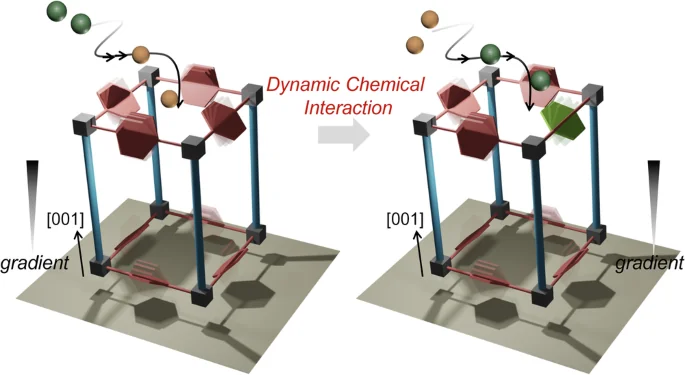
The movement of molecules (i.e. diffusion) within angstrom-scale pores of porous materials such as metal-organic frameworks (MOFs) and zeolites is influenced by multiple complex factors that can be challenging to assess and manipulate. Nevertheless, understanding and controlling this diffusion phenomenon is crucial for advancing energy-economic membrane-based chemical separation technologies, as well as for heterogeneous catalysis and sensing applications. Through precise assessment of the factors influencing diffusion within a porous metal-organic framework (MOF) thin film, we have developed a chemical strategy to manipulate and reverse chemical isomer diffusion selectivity. In the process of cognizing the molecular diffusion within oriented, angstrom-scale channels of MOF thin film, we have unveiled a dynamic chemical interaction between the adsorbate (chemical isomers) and the MOF using a combination of kinetic mass uptake experiments and molecular simulation. Leveraging the dynamic chemical interactions, we have reversed the haloalkane (positional) isomer diffusion selectivity, forging a chemical pathway to elevate the overall efficacy of membrane-based chemical separation and selective catalytic reactions.
Related work.
- Rapid Screening of Vapor Uptake by Ultra-Thin Polymer Films Using Surface Plasmon Resonance and Quartz Crystal Microbalance with Dissipation Monitoring 2025
- MoO3 Coated Quartz Crystal Microbalance as a Room Temperature Ammonia Sensing Platform 2025
- Chitosan/Sn@C composite nanofiber coatings for QCM-based humidity sensing 2026
- A QCM-Based Device for Neurodegenerative Diseases Detection in Human Perspiration 2024
- Electrophoresis and Quartz Crystal Microbalance Instrumentation to Sense Nanoplastics in Water 2024
- Development of gold nanospikes-modified quartz crystal microbalance biosensor for prostate specific antigen detection 2024
Browse all papers.
Hundreds of peer-reviewed publications cite openQCM. Search full-text and filter by instrument, year, journal or topic.