
Scientific Paper
Chemically routed interpore molecular diffusion in metal-organic framework thin films
Abstract
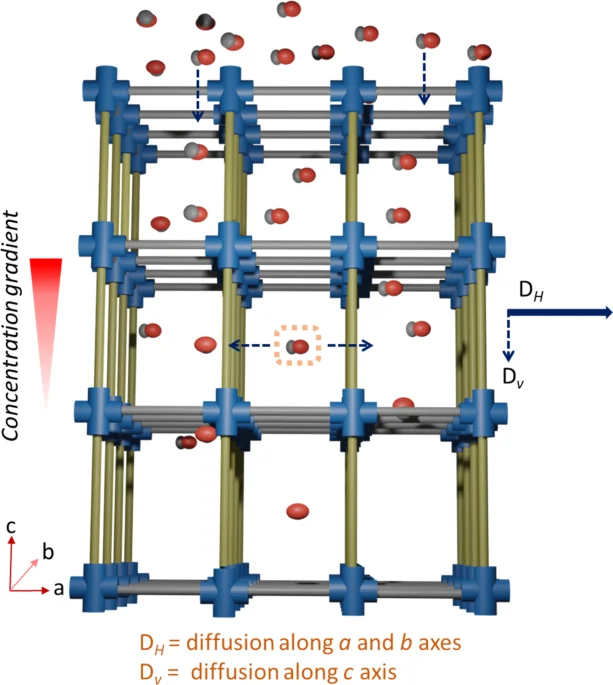
Transport diffusivity of molecules in a porous solid is constricted by the rate at which molecules move from one pore to the other, along the concentration gradient, i.e. by following Fickian diffusion. In heterogeneous porous materials, i.e. in the presence of pores of different sizes and chemical environments, diffusion rate and directionality remain tricky to estimate and adjust. In such a porous system, we have realized that molecular diffusion direction can be orthogonal to the concentration gradient. To experimentally determine this complex diffusion rate dependency and get insight of the microscopic diffusion pathway, we have designed a model nanoporous structure, metal-organic framework (MOF). In this model two chemically and geometrically distinct pore windows are spatially oriented by an epitaxial, layer-by-layer growth method. The specific design of the nanoporous channels and quantitative mass uptake rate measurements have indicated that the mass uptake is governed by the interpore diffusion along the direction orthogonal to the concentration gradient. This revelation allows chemically carving the nanopores, and accelerating the interpore diffusion and kinetic diffusion selectivity.
Related work.
- Rapid Screening of Vapor Uptake by Ultra-Thin Polymer Films Using Surface Plasmon Resonance and Quartz Crystal Microbalance with Dissipation Monitoring 2025
- MoO3 Coated Quartz Crystal Microbalance as a Room Temperature Ammonia Sensing Platform 2025
- Chitosan/Sn@C composite nanofiber coatings for QCM-based humidity sensing 2026
- A QCM-Based Device for Neurodegenerative Diseases Detection in Human Perspiration 2024
- Electrophoresis and Quartz Crystal Microbalance Instrumentation to Sense Nanoplastics in Water 2024
- Development of gold nanospikes-modified quartz crystal microbalance biosensor for prostate specific antigen detection 2024
Browse all papers.
Hundreds of peer-reviewed publications cite openQCM. Search full-text and filter by instrument, year, journal or topic.