
Scientific Paper
A highly sensitive safrole sensor based on polyvinyl acetate (PVAc) nanofiber-coated QCM
Abstract
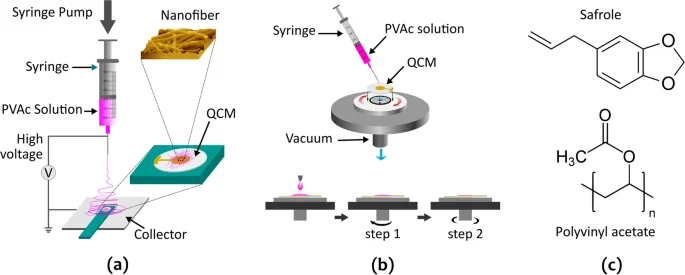
A novel, highly sensitive and selective safrole sensor has been developed using quartz crystal microbalance (QCM) coated with polyvinyl acetate (PVAc) nanofibers. The nanofibers were collected on the QCM sensing surface using an electrospinning method with an average diameter ranging from 612 nm to 698 nm and relatively high Q-factors (rigid coating). Scanning electron microscopy (SEM) and atomic force microscopy (AFM) were used to analyze the PVAc nanofiber surface morphology, confirming its high surface area and roughness, which are beneficial in improving the sensor sensitivity compared to its thin-film counterpart. The as-spun PVAc nanofiber sensor could demonstrate a safrole limit of detection (LOD) of down to 0.7 ppm with a response time of 171 s and a sensitivity of 1.866 Hz/ppm. It also showed good reproducibility, rapid response time, and excellent recovery. Moreover, cross-interference of the QCM sensor response to non-target gases was investigated, yielding very low cross-sensitivity and high selectivity of the safrole sensor. Owing to its high robustness and low fabrication cost, this proposed sensing device is expected to be a promising alternative to classical instrumental analytical methods for monitoring safrole-based drug precursors.
Related work.
- Rapid Screening of Vapor Uptake by Ultra-Thin Polymer Films Using Surface Plasmon Resonance and Quartz Crystal Microbalance with Dissipation Monitoring 2025
- MoO3 Coated Quartz Crystal Microbalance as a Room Temperature Ammonia Sensing Platform 2025
- Chitosan/Sn@C composite nanofiber coatings for QCM-based humidity sensing 2026
- A QCM-Based Device for Neurodegenerative Diseases Detection in Human Perspiration 2024
- Electrophoresis and Quartz Crystal Microbalance Instrumentation to Sense Nanoplastics in Water 2024
- Development of gold nanospikes-modified quartz crystal microbalance biosensor for prostate specific antigen detection 2024
Browse all papers.
Hundreds of peer-reviewed publications cite openQCM. Search full-text and filter by instrument, year, journal or topic.