
Benchtop instrumentsopenQCM NEXTQCM-D on every overtone, chamber held at ±0.01 °CopenQCM Q-1QCM-D on one selected overtone at a timeopenQCM Wi2Frequency QCM, USB-powered and wireless-ready
Sheet 04 · Electronics
openQCM Q-1A network analyzer, on a shield.
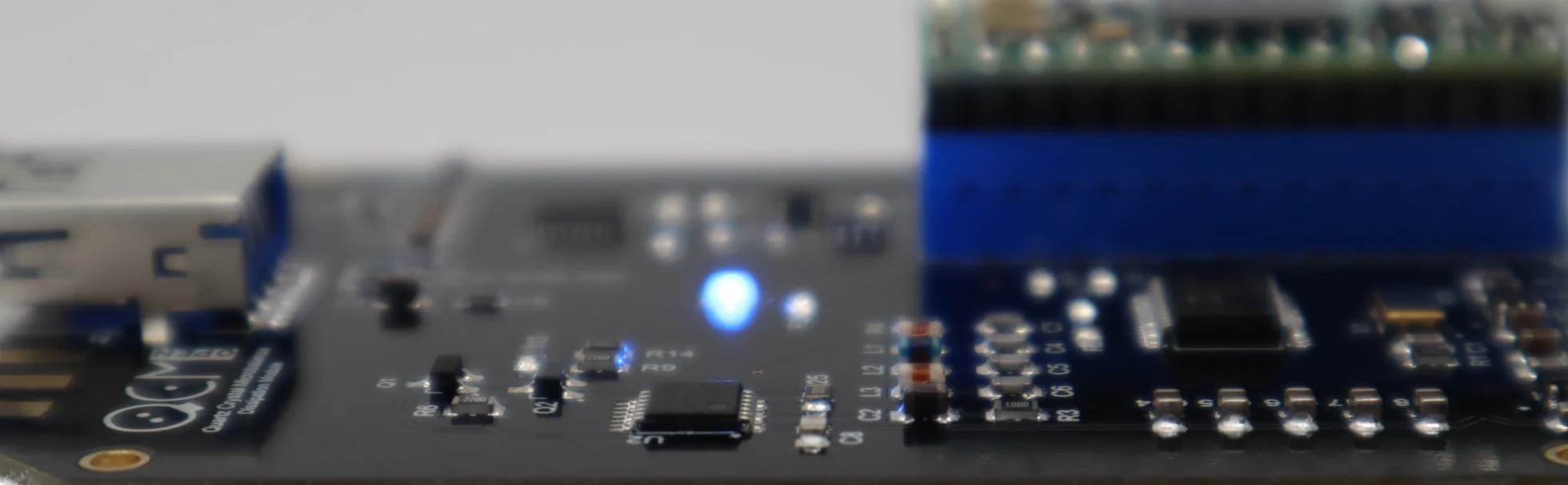
The openQCM Q-1 electronics is mainly comprised of a network analyzer, which passively interrogates the quartz sensor by sweeping the frequency around its resonance.
- Instrument
- openQCM Q-1
- Sheet
- 04 / 06
- Title
- Electronics
- Drawn
- openQCM · Pompeii
Block diagram
The signal path
- U1AD9851 DDSsteps the drive frequency around the chosen harmonic
- U2Quartz crystalin the sensor module, on two pogo pins
- U3AD8302gain and phase across the crystal
- U4TeensyADC with 13-bit effective resolution over 3.3 V
- U5USBcurves to the Python software
Network analyzer
Measure the crystal, nothing else.
The actuation signal is generated via the AD9851 DDS/DAC frequency synthesizer, and the resulting output is detected by the AD8302 gain-and-phase detector — quantifying both the gain across the quartz crystal and the phase difference between actuation and output signals.
Analyzing the gain curve characterises the sensor through concurrent measurement of resonance frequency and quality factor. A significant advantage of this approach is its ability to assess quartz parameters independently, mitigating interference from external circuitry.
Facts
The boards
- Main board
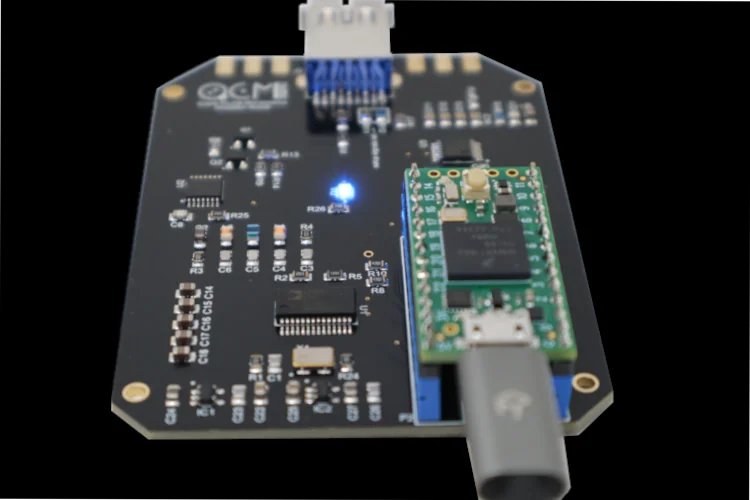
- 2 layers, 82.9 × 60.2 mm, FR-4 TG150, 1.6 mm, 1 oz copper, ENIG
- Key parts
- AD9851 DDS, AD8302 gain/phase, AD5252 digital potentiometer, LM7301 op-amp, two LP2985 regulators (5 V and 3.3 V), precision clock oscillator
- Parts count
- 72 components on the main board
- RF connectors
- 2 SMA (optional)
- Proximity board
- 31 × 29 mm, MCP9808 (±0.25 °C), two pogo pins, status LED, USB 3.0 connector to the main unit
- Schematics
- Open source